A Cotten Tale
by Joel Quentin Cotten
Virginia, El Salvador and Haiti
Our House in Burke, Virginia
During the period of my career as a Desk Officer, from early 1975 until about November 1976, we were also in the process of planning and building a new house in Burke, Virginia. It was a little ways out of town, but it was nice to be in the country again. The area where our house was built used to be a horse farm. We moved in sometime in September 1975. I arranged with some colleagues at the State Department who lived near by to participate in a car pool to get to work. There were four or five of us who took turns driving so we didn't have to drive every day and so we could use the express lane on the thruway into D.C. A real time saver.
There were of course other things happening during this Springfield period. I built a large deck on the back of the house with a big planterbox for herbs and a tree. The back lot sloped up sharply, with other houses at the top. I built terraces and gardens on this steep slope, sort of like the Nepalese. We were on a cul-de-sac and there was a wooded area at the edge of our lot. I remember dragging stones out of the woods with a wheelbarrow to build the terraces. Niki went to a school off Keene Mill Road and Glen at another school in Springfield. The small school in Burke was full. Margrit was busy housekeeping. Margrit's parents came to visit us from Germany during this time.

Margrit and her mother on our deck in Burke.
Juniper and the stone terraces I built in our back yard in Burke.

I was glad to have them with us, and that Margrit's father was able to see that his Kessi was happy and well taken care of.
We moved into our house in Burke in September 1975. The house was a split foyer. When you walked in the front door you were on the foyer landing and could either walk down a few steps into the family room with a fireplace, or a few steps up into the living room kitchen area. The family room level of the house was partially below ground level. The family room was in the front half of the house, and the room behind that was unfinished when we moved in. It also had an area with roughed in plumbing for a bathroom. I finished the back room myself and also finished the roughed in bathroom

Here's a link to a Google view of our house at 6100 Lundy Place in Burke, Virginia:
https://goo.gl/maps/kYyhujKRNJp
Around this time I was approached to replace the Program Officer at the USAID Mission in San Salvador, El Salvador, who was scheduled to go on home leave in a few months. I had enough time to begin Spanish language training, and started a total immersion Berlitz tutorial class in D.C. right away. For the next 6 weeks I spent 8 hours a day with a single tutor, one-on-one, speaking Spanish. The Foreign Service language training approach consists of very little grammar, and almost “total immersion” in speaking. The text offers little written scenarios from every day life, and you use these as a guide to conversation on a variety of situations. The key is repetition and more repetition. In about four weeks I achieved level 2 in speaking and reading. Language proficiency in the Foreign Service is scored from 1 to 5, where 1 is beginner and 5 is a native speaker. So I had a ways to go, but at least I could survive if I found myself alone on the streets of San Salvador. I could always ask for a Pupusa and a Cervesa, making sure, of course, that I always said “por favor”.
El Salvador 1977 - 1978
The approach to San Salvador by air was quite impressive. Central America has a lot of volcanoes, and El Salvador certainly has its share. I don't remember how many I saw flying into the airport, but it seemed like a lot. One of the volcanoes of El Salvador is very famous. We actually saw it. As the story goes, there was this one volcano which was constantly erupting, not violently, but constantly spewing flame and ash over a perfect black cone. The eruption was so continuous and regular that its light was used by ships to navigate along the coast. So a guy got the idea that he would build a hotel near the volcano with a huge observation deck, and tourists would be attracted to the hotel to view this fantastic phenomenon of nature. The construction of the hotel wasn't easy. They first had to build a road to the site, which was very remote and mountainous. It took years to complete the project, but it was finally finished, and they announced the opening of the hotel and platform to view this unique volcanic spectacle. As if on queue, as soon as the hotel opened, the volcano quit. The hotel is still a place to go, to see the black cone of what used to be the volcano that never quit.


Glen, Niki and Margrit, and the volcano that never quit. Thought I was kidding?
We ended up living in an area called Escalon. You guessed it - on the side of a volcano, albeit, an extinct volcano. The USAID offices were in the Embassy building and I drove down the mountain, through town, to work each morning. I remember following the Ambassador down to work one morning. He was accompanied by two chase cars. It was quite an operation. All the way down the mountain, the lead car would stop at each cross street, blocking the traffic, while the Ambassador and his chase car would drive through. The chase car then took the lead, and so on all the way to the Embassy. The Ambassadors car never had to stop. There was a need for this special security, because there was guerilla activity in the rural areas of Central America.
El Salvador has historically been characterized by marked socioeconomic inequality. In the late 19th century coffee became a major cash crop, bringing in about 95% of the country's income. However, this income was restricted to only 2% of the population, exacerbating a divide between a small but powerful land owning elite and an impoverished majority.
On July 14, 1969, an armed conflict erupted between El Salvador and Honduras over immigration disputes caused by Honduran land reform laws. The conflict lasted only a few days, but had major long-term effects for Salvadoran society. Trade was disrupted between El Salvador and Honduras, causing tremendous economic damage to both nations.
I experienced the effects of this conflict even when I was there in 1977-78. I travelled with a friend, an archeologist from Harvard University, to Copan, a Mayan historical site in Honduras, while I was in El Salvador. Harvard University did archeological excavation in Copan. As a matter of fact, they removed artifacts from there, which are now on display at the Peabody Museum of Archaeology and Ethnology. I saw a place on the famous hieroglyphic staircase on one of the temples, where an entire stone step is missing. It's at the Peabody. Even at that time, we could not cross the border between El Salvador and Honduras, but had to go through Guatemala to cross the border there.
Historical Note: During this time there was a revolution in Nicaragua just to our South. Here is a reference to this period:
https://en.wikipedia.org/wiki/History_of_Nicaragua#Sandinista_period_(1979%E2%80%931990)
The Mayan Empire
Evidence of the Mayan civilization is unavoidable in the region. Their art and architecture are everywhere. The Mayan Empire, centered in the tropical lowlands of what is now Guatemala, reached the peak of its power and influence around the sixth century A.D. The Maya excelled at agriculture, pottery, hieroglyphic writing, calendar-making and mathematics, and left behind an astonishing amount of impressive architecture and symbolic artwork. Most of the great stone cities of the Maya were abandoned by A.D. 900, however, and since the 19th century scholars have debated what might have caused this dramatic decline. Learn more about this amazing civilization here: https://en.wikipedia.org/wiki/Maya_civilization
Copan was an amazing place to visit. There was a small town near a jungle. We walked into the jungle to a clearing – a large plaza with stone monuments, called stella, in various locations around the clearing. Around the periphery of the plaza, where the jungle was encroaching, were a number of temples. There was also a stone structure that looked like a stadium open on two ends. We learned that this was a sports field for a special ball game.


Mayan art inspired me to develop a sculpting technique to replicate the Mayan stella and other stone sculptures. In some cases I actually sculpted in stone, but I also used plastilina (modelling clay) to create the piece, and then painted a liquid latex over the piece. When it dried, I poured a plaster mold over that. When the plaster dried, I first removed the plaster mold and then pulled the stretchable latex off the plastilina sculpture. I then put the latex mold back in the plaster mold for support. I experimented with different materials for the finished pieces, but finally settled on a commercial product called sculptamold, I bought from an art supply house in the US. It was a white powder with cellulose fiber in it. I mixed it with water and poured it into the mold. When it dried it was hard, but light like a piece of wood. I then finished the piece with acrylic paint to get the effect I desired and usually mounted it on wood or framed it.
An example of a piece done using this process is the picture below. The subject is a Mayan prisoner bound for sacrifice. The circular piece was actually a relief carved on the top of a stone altar located in Tikal, a Mayan city in Guatemala.

Another piece I did during this period was carved in stone. It's the head of a Mayan Lord. If you look closely at the piece below, you can see that there is a vein of fine pumis, almost like chalk, running through the rock into which I carved the head. Both pieces are displayed in our home in Fearrington Village, North Carolina.
Carlos Mejia was a local artist who exhibited his work internationally. We became good friends, and he arranged with a local bank to exhibit my work.
Casa Bank financed the entire thing. They printed a brochure promoting the show at their Bank and paid for ads in the local paper. The only thing they required is that I open an account with them and deposit the proceeds from the sale of my art work in the account.
The Bank of course received significant publicity from the event.


Leah Becker Encounter
Another episode which relates tangentially to this period, and to earlier periods already mentioned, is my encounter with Leah Becker. This “small world” story has its beginnings in a Pan Am flight when I was returning home from my India-Nepal sojourn. We were at cruising altitude and I was just getting settled in for a long flight home. The plane was not full and I didn't have anyone sitting next to me. I was unexpectedly interrupted by a pretty face looking at me over the seat in front of me. She asked if I would get something out of the overhead bin for her. I got up and walked to her seat – there was no one sitting next to her either. I immediately noticed that she was a midget. She was standing on her seat – just tall enough to peer over the back of her seat to ask me for help. I got what she wanted from the bin and decided to sit down next to her, and we started to talk. Here's where we both discovered how small the world really is. She explained that she was returning to NYC from a trekking expedition in Nepal. She told me that she worked for ABC as a graphic artist. I told her about my work with AID and that I was returning from an evaluation of the FFP program in India and Nepal. Eventually the subject turned to music and I told her about my studies with Mrs. Patton and time I spent in New York. As soon as I mentioned Mrs. Patton, she looked surprised and said that a colleague of hers, who also worked for ABC, was named Lowell Patton. So there's a small world story for you. At 36,000 feet in a Pan Am jet, I meet a 4 feet tall girl, who works with the son of the vocal teacher I met in Buffalo over 20 years earlier.
But there's more to the convoluted story. While reporting to CRS in NYC on the findings of my FFP evaluation in India, sometime in the Summer of 1976, I decided to stop in at the ABC tower in the city to look up Leah Becker. She invited me up to her work place, an open office area, with many cubicles as I recall. She introduced me to some of her colleagues and showed me some of the work she was doing. We decided to contact Lowell and arrange to get together for lunch with him and his mother. Mrs Patton, as you may recall, lived in Leonia, NJ, just at the foot of the George Washington bridge. so it was easy for her to catch a bus into the city. We all had a very happy reunion and a nice lunch.
But wait, there's more! Here we are now in El Salvador – it's 1978. I've discovered the Mayan civilization and am creating sculptures inspired by their art. It must have been at this time that I wrote a letter to Leah Becker in NY to tell her about my art work. In the process of writing this autobiography, I dug back through my files. In a folder containing pictures and material from my art, I came across an art brochure created by Leah at ABC for a children's TV program series about “ Animals, Animals, Animals”, a quality mixture of graphics, animation, and live action, focusing on a particular animal in each segment, as seen through the eyes of man, a series for which ABC received the George Foster Peabody Award. Inside the brochure was a letter from Leah, dated Jan. 15, 1978, which she apparently wrote in response to a letter from me. I want to rewrite the letter here, because it ties this story together so nicely. She wrote:
Dear Joel,
It was truly good to hear from you and realize our friendship still stands after that incredible discovery of our small world on our Pan Am flight around the world. I too miss Asia. I have not returned to Nepal, although stay in touch with two Sherpas I made friends with. I write letters and send them books. They love novels. One never knows when one will cut all this off and decide to climb the hills again. Nepal so inspired me that it got me started on a proposal for a grant there. I'm waiting for an endorsement from Sir Edmond Hillary. Both of his literary agents read it and thought it merited realization. So, hope for me.
Lowell. Like me, is still at ABC. Occasionally he has been free-lancing, designing & constructing stage sets. He needs something more – but he will do it at his own pace, I suppose. He is rich in skill & talent, it's just a lack of “pushiness” necessary in this part of the world or perhaps everywhere on the planet. I'd like to think it's not a necessary requirement. Oh well.
Meanwhile, the work you describe to me sounds fascinating. Please do send me a brochure of the show and tell me more about it. Studying Mayan art must help you integrate some of the professional work you're doing. And even if it doesn't, I assume it's providing some happiness to the artist inside you.
Enclosed is the latest project I designed for a children's TV show. I had to use photos straight from 16mm film – make all sorts of collages & juxtapositions. It was fun. My favorite is the cover, because it's the most conceptual & all from inside me.
I wish you and your family a healthy and happy New Year. And do write when an occasion comes up. I'm going to revive some of my art history reading in the area of Mayan art.
Always - Leah
[An historical note. During this time the Iranian revolution is evolving, culminating in the overthrow of the Pahlavi dynasty under Shah Mohammad Reza Pahlavi, and the replacement of his government with an Islamic republic under the Grand Ayatollah Ruhollah Khomeini, a leader of one of the factions in the revolt. The revolution was supported by various Islamist and leftist organizations and student movements]
In spite of the political unrest in El Salvador, USAID carried out programs in public health, education, economic development and agriculture. Most of USAID’s assistance in health was directed towards reducing infant, child, and maternal mortality. Through direct support for health services, training of public health providers, provision of hospital and clinical equipment, and construction of hospitals and clinics, and capacity building in local health related NGOs, mortality rates dropped dramatically. USAID played a key role in keeping El Salvador’s economy moving during the war years and during the transition from war to peace, building or rehabilitating roads, bridges, and repairs to the electrical grid.
One of USAID’s greatest achievements was its dynamic role in the formation of key institutions essential for democratic governance and socio-economic development. USAID played a direct role in the establishment and strengthening of a number of local organizations, which today provide independent analysis, oversight and solutions to the major problems confronting the country.
Trip to Guatemala (Antigua, Lake Atitlan, Chichicastenango)
We took a trip together by car during our tour in El Salvador. We drove into Guatemala to Antigua, Lake Atitlan, Chichicastenango and some other places.
Lake Atitla was spectacular as you can see by the pictures below. We were there in the off-season for tourists, so we had the hotel almost to ourselves. We walked into the little town nearby to eat, and found a small Chinese eatery. We sat down and looked at the menu. When the waiter came, we each ordered something from the menu, and to each the waiter responded with “no hay” (“don't have it”). We looked at each other, and asked for something else on the menu. The waiter says “no hay”. We thought this was pretty funny. Now this being a Chinese restaurant, I thought to myself, “what do all Chinese restaurants surely have?” Ignoring the menu, I asked for some steamed rice, “No hay”, was the reply. We all had a good laugh. So I asked the waiter, "¿Qué tienes?" ... “What DO you have?” He told us …. and that's what we all ate. It wasn't bad!


The other places we visited were also memorable. At one place that we stayed, we were serenaded by a marimba band (see above). I think it was Antigua, but I'm not sure.
If you want to experience the flavor of any of these places, all you have to do now-a-days is type the name of the place into your favorite browser and it will take you there.
It's amazing what technology gives us today, that didn't even exist 30 years ago, when we took this trip.
Chichicastenango was another fun place. Just to walk in the streets and visit the markets was a picnic for the eyes and sometimes an assault on the nose. The indigenous people in the area were probably descended from the Maya. I'll never forget the brilliant colors worn by the native women. Here are some more photos I took during this trip.


After our tour in El Salvador my next assignment was Haiti, one of the poorest countries in the western hemisphere. We didn't go directly to Haiti, because I had accrued some leave time and we also had to make some arrangements in the States for Glen's schooling, because he was now in high school and Haiti did not have an accredited high school program.
We stayed in the Sheraton Hotel for a few days before we flew to Miami. I had made about $4000 from my art show, and we decided to use it to go to Germany to see Margrit's family. We actually flew to Luxemberg and Margrit's father picked us up and took us to Auerbach where they then lived.
Auerbach is in Hessen, on the Bergstrasse, a beautiful wine-growing region, between Darmstadt and Heidelberg, with the mountains of the Odenwald on the left as you drive South on the autobahn from Frankfort airport. This is like home to me now, because Margrit's siblings, two sisters and a brother, still live in the area, and we visit there whenever we go to Germany. As you approach Bensheim, which has now incorporated Auerbach, you begin to see the old castles perched on the tops of the mountains, and you feel like you're home. In the local dialect, “Ich bin da heim”.
After our visit to Germany, we flew Iceland Air from Luxemberg to New York and then from there to Massachusetts. We had researched boarding schools for Glen and Northfield-Mount Hermon was highly recommended. We checked it out and decided that it would be a good school for Glen while we were in Haiti. We then went to Eden for a few days and from there to Haiti. It was now July, 1978.
Haïti
Jean-Claude Duvalier "Baby Doc" was President at the time we arrived. He succeeded his father François "Papa Doc" Duvalier as the ruler of Haiti after his father's death in 1971. He was the President of Haiti from 1971 until he was overthrown by a popular uprising in February 1986, shortly after we left in 1983. Here's a link to the Duvalier regime:
https://en.wikipedia.org/wiki/Jean-Claude_Duvalier
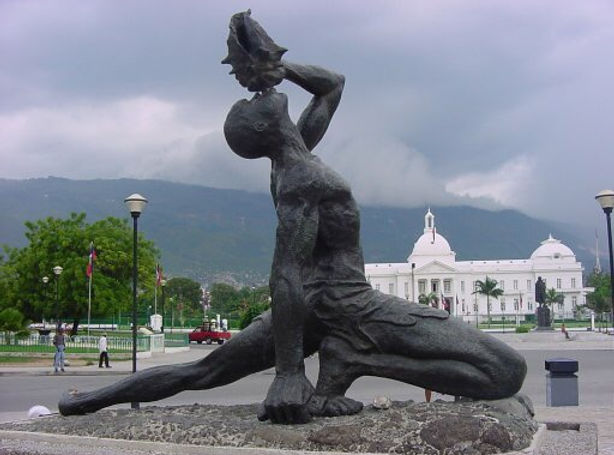
The picture below shows the Palace, which was destroyed by the devastating earthquake of 2010, and the famous statue of the freed slave with conch, which survived the quake.
Harry Belefonte sings the beautiful Haiti Cherie:
https://www.youtube.com/watch?v=VpjZx4iCNX4
A driver from the Embassy picked us up at the airport, and drove us to our apartment in Bourdon Park, high above Port au Prince, with a panoramic view of the city and the ocean beyond. The street we drove along on the way from the airport went through a poor slum area and was crowded with people. I mean the street was full of people. The driver had to drive very slowly and use his horn to get the people to move out of the way.
We were only in the apartment for a short time, and then moved to a three story house which happened to be right next door. The house was really nice – plenty of room for visitors. I used the lower floor for my art studio. It had good light and a stone terrace to the back yard, which had several palm trees and flowering bushes.
In September, Glen flew alone to Northfield to start school and Niki went to school in Port au Prince. I started work as Chief of the Research and Evaluation Division, designing and conducting evaluations of the various projects that were implemented by Private Voluntary Organizations (PVOs). I was also the Project Manager for the La Gonâve Potable Water Project. La Gonâve is an island just off the coast of Port-au-Prince in the Gulf of Gonâve. From our house, you could see the dim outline of La Gonâve on the horizon. The island is 37 miles long and 9 miles wide, and had a population in 1978 of about 70,000. Today the population is about 120,000. That's an amazing population growth in about 40 years, especially on an island that could hardly support the 1978 population.

This is the upper terrace of our house in Bourdon Park.
You can see a silhouette of Glen playing the piano in the house, at the left of the picture.
This picture is one of my favorites. It was taken on the second floor balcony of our house in the evening, looking out over the sea. Although you can't see them in this picture, the lights of Port-au-Prince are sparkling below us.
Margrit is silhouetted against the evening sky and two glasses of wine pick up the light of the evening sunset.


This view and the one below show the dim outline of the island of La Gonave on the right.
This was the view from the lower terrace of our house in Bourdon Park.

At the time I became the USAID Project Manager for the potable water project, there were two PVOs (Private Voluntary Organizations) with activities on the island. Church World Service (CWS) operated a hospital there and Catholic Relief Services (CRS) also carried out health projects. I think it was CWS that led the effort to identify most of the natural springs on the island and put a concrete cap over the source (captage) to keep it from being contaminated, and piped the water to a simple fountain near a road for easier access.
We wanted to increase the availability of water, so the next phase of the project was to drill wells. I couldn't get either CWS or CRS to lead the new project, so I identified a new voluntary agency named Compassion International to implement it. They hired a young Dutch hydrologist, named Hans Spruitt, to do a geological survey of the entire island and identify acquifers we could access by drilling. Hans was a great choice. He lived on the island during his survey, where living conditions were pretty primitive. The Haitians in the Ministries responsible for La Gonave, could seldom be seen on the island. They might come for a meeting or a ceremony, but would usually return the same day.
Hans completed his survey, so we took his hydrological maps and overlayed them onto a map of roads and population centers, and in that way identified the best places to drill so the largest number of people had easy access to the water. USAID financed the purchase of a mobile drilling rig, and when it arrived, we had it transported to a place on the North coast where it was loaded onto a sailing vessel and floated to the island. As soon as it arrived we were ready to start drilling. We drilled nearly a well a week until all the prime sites were done. As soon as water was struck and the pipe capped, we installed a simple manually operated pump. We also organized the communities to manage the use and maintenance of the sites. Local organizations called Groupment were established, officials were elected and responsibilities assigned.
In my role as Program Evaluation Officer, I wrote up a special report on the Potable Water Project. Having sent many evaluation reports to AID/W to provide Congress with information to determine funding levels for our activities in the field, I know that they are seldom read. So for this project report, I decided to do a kind of comic book or picture book, which showed the impact of the project on the lives of the local peasants.
It was a big success. From that point on, I spent more time escorting Congressional Staffers to La Gonave to see this highly successful water project, than I spent managing the completion of the project. By then it pretty much managed itself anyway.
I received numerous awards and commendations in my career as a Program Evaluation Officer, but the one I think I was proudest of was a commendation from the Director of Compassion International to the AID Administrator praising my work as project manager of the La Gonave Potable Water Project in 1981.


This is a typical fountain we built in Haiti. You can see the water is running constantly from two pipes. There are no valves, which could break and have to be repaired. The water, which is piped to the fountain from a natural source near by, runs into a catch basin where the women can wash clothes, and then simply overflows into the fields to water crops.


I went out from time to time to inspect the work of our PVOs.
The water was clean, cold and refreshing.
I wasn't showing them how it worked, just quenching my thirst.

The School Feeding Program - A Longitudinal Evaluation
Another major undertaking during my tour in Haiti was a longitudinal study of our school feeding program. By longitudinal I mean an evaluation conducted over a two year period using the same cohort of children to determine the impact of school feeding on cognitive and physical development. We actually took physical measurement of weight, height and arm girth, and administered a simple cognitive test. Then repeated the same tests on the same children two years later. I hired local people to assist in the survey covering the entire country using randomly selected schools. I also hired some people at the University of Michigan at Ann Arbor to do the statistical analysis of the final data. They determined that the sample size was adequate, and that the results showed that in fact the school feeding program had a significant impact on cognitive development of the children tested. I went to Ann Arbor to discuss the results of our study. The study has been published and is considered one of the uniquely definitive studies on the subject.
Haiti is a very interesting place to explore and we did our share of travelling, from Cap Haitien in the North to Jacmel in the South and everywhere in between. Haiti shares the island of Hispaniola with the Dominican Republic to its east. We also travelled there by car while we were in Haiti. Many of Haiti's landmarks dating to the early 19th century remain intact. These include the Citadelle, a mountaintop fortress, and the nearby ruins of Sans-Souci Palace, the former royal home of King Henry I, or Henri Christophe. Follow this link to learn more about Haitian history: https://en.wikipedia.org/wiki/History_of_Haiti

The one-man band. He's playing a kazoo, a home-made banjo and a drum all by himself. Hilarious!


The last two pictures above are in Jacmel on the southern peninsula of the island looking south into the Caribbean.
Moro Baruk, a Baha'i artist and pioneer, lived in Jacmel then and still does. I had built myself a kiln out of ceramic fiber, while in Haiti, to experiment with firing ceramic pieces. When we left Haiti, I gave the kiln to Moro. He is a prolific artist and works with the locals to produce a variety things including beautiful painted fabrics. Just "Google" Moro Baruk to read more about him.