A Cotten Tale
by Joel Quentin Cotten
Travels and Special Events
I've already mentioned several places we visited after retirement, including Sweden and Germany. Here I'm going to elaborate a little more, provide some more pictures and mention some of my favorite food, most of which you can't find in the U.S. Click the link below for a video of Bensheim on the Bergstrasse:
https://www.youtube.com/watch?v=6q2WxT8qxAE
The links below are a video in German called "Hessische Toskana" or "Hessen Tuscany"
because Hessen in Germany has a mountainous topography and a mild climate like Tuscany in Italy, ideal for wine production. Play them in sequence.
Israel 2000
About a year after Glen and Isik were married, we visited them in Haifa and travelled around Israel to several places, including Edirne and Akka, places where Baha'u'llah, the founder of the Baha'i Faith, was exiled and imprisoned; the Sea of Galilee; the Dead Sea; various places on Mount Carmel, including the Baha'i World Center; and also to Jerusalem for several days.
The Baha'i World Center on Mt. Carmel in Haifa, Israel


The Baha'i World Center is located on the slopes of Mount Carmel. Here is the link to a documentary I did in 1998 which tells the story of Mount Carmel and the spectacular terraces and gardens which adorn the Baha'i World Center erected on the slopes of that holy mountain. The documentary is called "The City of God".
https://www.youtube.com/watch?v=vElEwzDK9AQ&t=942s
The terraces and steps to the Shrine of the Bàb and up to the promontory are perfectly aligned with the main street of the old Templer colony. The Templers were a German Pietist community who emigrated to the Holy Land and built a colony in Haifa, at the foot of Mount Carmel, in anticipation of the return of Christ. I produced a documentary about the Adventist movements within both Christianity and Islam and their fulfillment in the Baha'i Faith. Here's the link to that documentary entitled "What Hath God Wrought".
https://www.youtube.com/playlist?list=PLprbRoa4weoxLFJTJAFKpByH1sBADpgX-

This is a view of the Baha'i terraces and gardens from the top of Mount Carmel to the Shrine of the Bab, showing the alignment with Haifa's main street still lined with houses from the old German Templer Colony.
Jerusalem


An inscription in the Dome of the Rock, above left, establishes its date of completion as 691–692—some 55 years after Muslim armies captured Jerusalem, then a predominantly Christian city, from the Byzantine Empire.
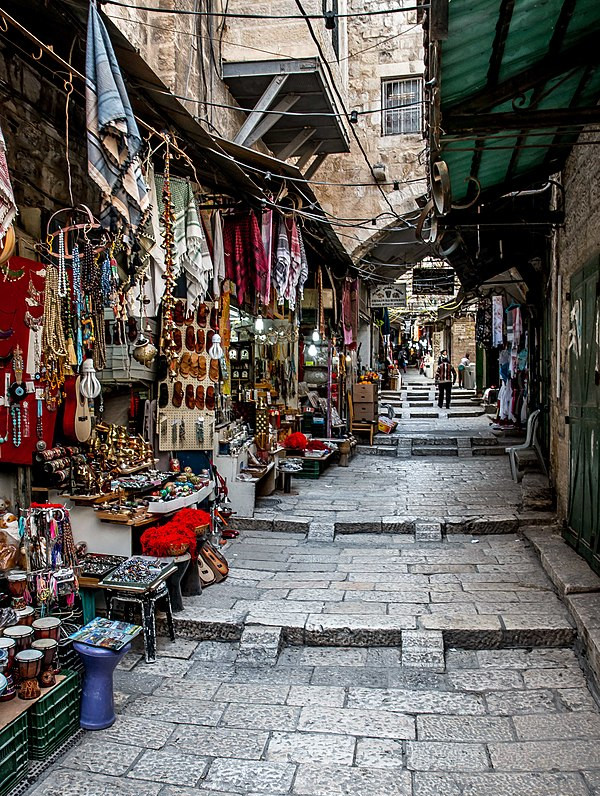
The Arab souk in the Muslim Quarter, left, extends from the Damascus Gate to the Via Dolorosa. Its many stalls sell spices, pastries, embroidered dresses, sheepskin coats, leather goods, antiquities and other handicrafts,

Most restaurants and sidewalk cafes serve hummus as a meal. It's delicious with olive oil and pine nuts.
The best snack to be eaten in Jerusalem is falafel. This is a ball of chickpea meal with fresh herbs and spices, or they are deep fried and eaten alone or stuffed in a pita along with some salad, tahini (sesame paste), hummus and possibly pickles. Also, a falafel sandwich makes the best meal on the go in Jerusalem.

Edirne, known in antiquity as Adrianople


On the way to Edirne (ancient Adrianople), which is in European Turkey, we passed fields of sunflowers. Dried and salted sunflower seeds are eaten as a snack.
Below is the house where Baha'u'llah lived for approximately five years, during the Edirne period. The Tablet of Ahmad was written during this time as well as many of the epistles to the kings and rulers of the world.


The Selimiye Mosque is an Ottoman imperial mosque commissioned by Sultan Selim II, and built by architect Mimar Sinan between 1569 and 1575. Baha'u'llah used to visit this mosque during his time in Edirne. I produced a documentary about the Tablet of Ahmad. Here's the link: https://www.youtube.com/playlist?list=PLprbRoa4weoy1ZLSmvt4BjgrRXtRr4DQV
Turkey 2007

We went to Antalya from Ankara by bus and from there drove up the Mediterranean coast of Turkey to Kalkan and Cirali. Mike, Niki and the kids flew down from Sweden to join us.
Antalya was founded by Attalos II, King of Pergamon, in 150 bce, but the ancient sites remaining in the city date from Antalya’s Roman period.


The most famous ancient landmark of Antalya is Hadrian’s Gate (above), built by the Roman emperor in the 2d century.
The picture above of the family around a table depicts Margrit's 70th birthday celebration in a restaurant in Kalkan near the waterfront. We had a local fish, but can't remember what kind.
We drove North from Ankara to Safranbolu, a UNESCO World Heritage site preserving Ottoman architecture. At right, we're sitting in an old caravanserie converted into a restaurant.
A caravanserie, as the name implies, is a place where camel caravans, transporting goods on the, so called, Silk Road, running from China to Europe, would stop to rest. We are sitting in an archway surrounding a large open area where the camels would be tethered and fed.

Istanbul, ancient Constantinople
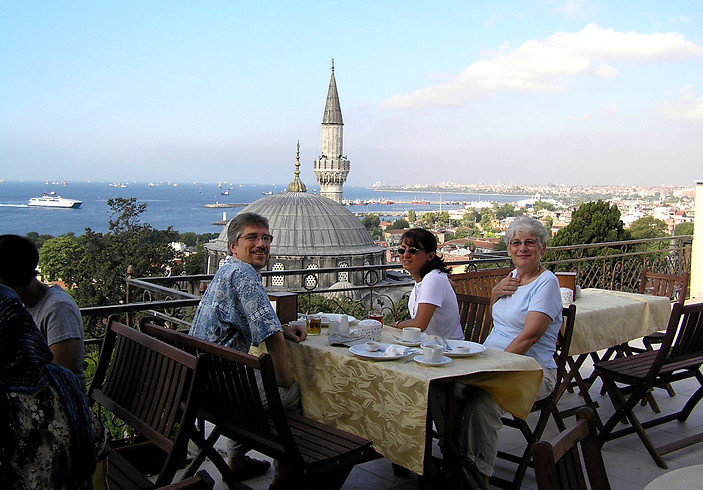
While in Istanbul, we stayed at the ATA Hotel with a roof terrace overlooking the Sokollu Mehmed Pasha Mosque and the Sea of Marmara. We ate breakfast on the roof and sat there in the evening to watch the sunset and listen to the call to prayer echoing from near and far - a most enchanting experience.
The Hippodrome was the sporting and social center of Constantinople, capital of the Byzantine Empire. Today it is called Sultan Ahmet Square. We walked thru this area on the way to visit the Aya Sophia, the Blue Mosque and other historical sites of Istanbul.
For more on this historical site visit this website:


Sweden 2009
In August, 2009, Gisela and Jan, our friends from Eden on the Bay, Florida, celebrated their joint 60th birthdays, and invited all their Florida friends, including us, to their home on Sandhamn island in the Swedish archipelago. We had to take a ferry to the island from Stockholm. They invited Margrit and me to stay in their house with them for the celebration.

Here we are in Stockholm to pick up the ferry to Sandhamn.
That's Jim Heffner , Gisela and Karin Heffner on the left. The Heffners were our next door neighbors at Eden on the Bay.
Not sure who the other couple is.
The ferry made several stops at other islands on the way to Sandhamn.
In the picture you can see how the bow lifted to let passengers on and off.
It took about two hours to get to Sandhamn with all the stops on the way.


Gisela and Jan
Welcome to our 60th birthday celebration!
Skål !
Changing of the Guard at the Presidential Palace in Stockholm.
Fun to watch!

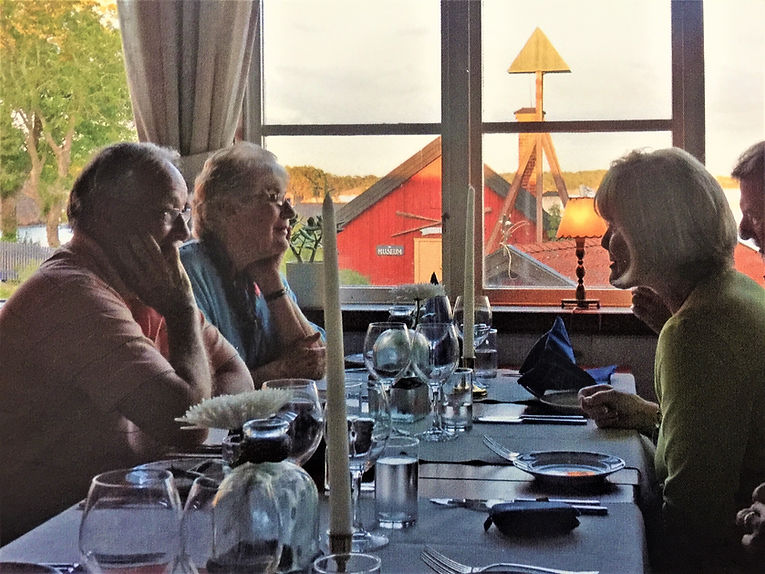
Nothing great here, except maybe the breads and cheese spreads.


Jim Heffner likes it.
I had a hard time learning how to drive that ridiculous delivery bike. The handle bars were so far from the front wheel. Weird!


The Bergstrasse
I love the Bergstrasse. I could live there. It runs for about 60 kilometers along a range of mountains from Darmstadt to Heidelberg, with the Odenwald forest to the East and the Rhine river plain to the West. The region is also known as the Hessische Toscana, because it's like Tuscany, Italy, in terms of climate and topography. The mountainsides are covered with vineyards and crowned with medieval castles at intervals along the way. The towns of Bensheim, Auerbach and Zwingenberg, where Margrit's family still lives, are located about halfway between Darmstadt and Heidelberg.

When we go to Bensheim, we usually stay at Gaby's little apartment. It's small, but very convenient to everything. This is a view from her balcony to the Basinus Bad or public swim hall. We can walk into town easily from here..
Just follow the pictures below for a walk into Bensheim's main plaza.

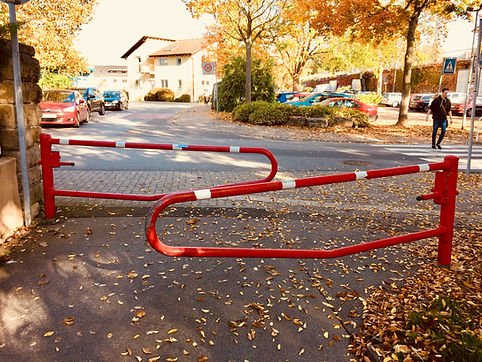
The red bars at the right are to slow down bikes at the cross road. We would be walking like the man in the picture, thru the barrier and down the little wooded path below, which takes us to the Bahnhof at the end of the path.

Go into this passageway to go to the trains. Stairs lead up to the tracks. You can see the red cars waiting for passengers to get on.
Walk thru the tunnel to some little shops and the bike ramp and pedestrian steps that take you beneath a street and into town.



The plaza on the left is in front of the Bacchus Hotel and leads into town past a little Turkish fruit and vegetable store with a stand out front which is always full of fresh produce from the countries of the European Union.
Below is the fruit stand showing among other things those delicious flat peaches from Spain (Pfürsiche aus Spanien) for 2.49 Euro a kilo.


The walkway at the left leads to the main plaza. The tower at the end is one of the twin towers of the St. Georg Cathedral, one of the most prominent landmarks of central Bensheim.
Below is the same street leading progressively closer to the plaza. Just turn right at the end.
The plaza has a fountain with a statue of St. George slaying the dragon of medieval lore.
At least once a week there is a fresh market in the plaza, as shown in the pictures below.

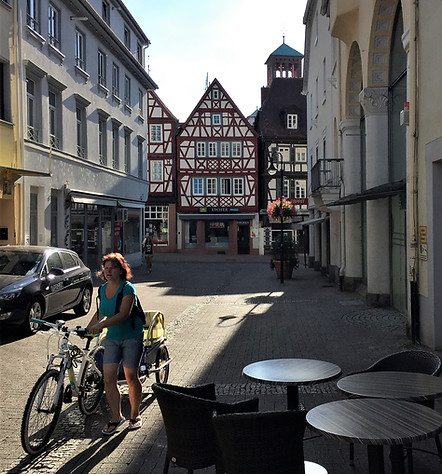

Walking to the right you reach the Mittelbrücke, over the little Lauter or Winkelbach, and into a long pedestrian plaza with many shops and cafés.


Here I'm enjoying a Bit across from an historic Jewish Gebetshaus, where before the wars, Jewish residents of Bensheim would gather. You can see the Menorah symbol on the house.
Just down the promenade from the Jewish Gebetshaus is another great eatery, the Nibelungen Cafe.
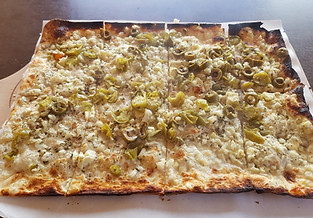
Below Gaby and Margrit are enjoying some Flammkuchen - a Hessian specialty. I love the ones with goat cheese, olives and pepperoncini or onion.
Here are some great examples.


Auerbacher Kerb


Kerb is a church celebration in October each year which includes parades, singing and great food. Horst invited me for one of my favorite dishes - Rippchen mit Kraut. Rippchen is a marinated pork chop that is steamed and served with some of the most delicious sauerkraut you'll ever eat. The Rippchen is moist, and so tender you can cut it with a fork. Unfortunately, I have yet to find it in the U.S. Maybe in a good German restaurant.


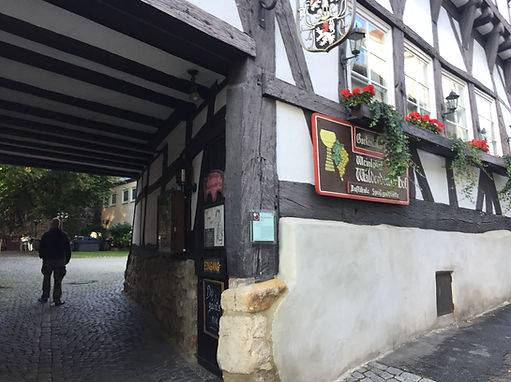
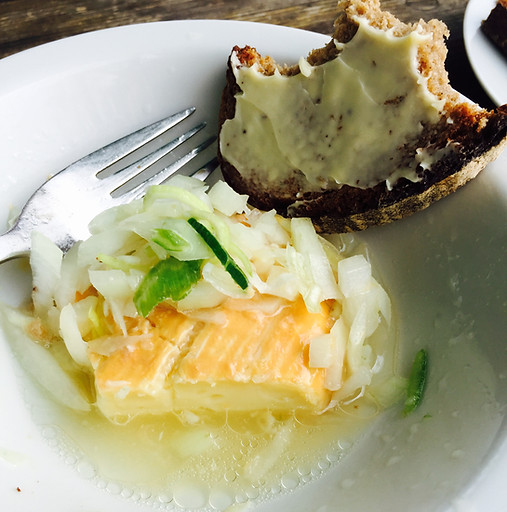
One of the great restaurants in Bensheim is in one of the oldest fachwerk häuser in town called the Walderdorffer Hof. We ate there one evening. I had Matjes Herring, another dish you'd be hard pressed to find in the U.S.
Matjes is often served cold in a salad. It's delicious no matter how it's served.


Rollmops
I also talked about eating Rollmops when Wolf and I drove to Aachen to see Margrit for the first time. This is what we had that evening with a fresh local beer and a slice of Bauernbrot.
At left is a picture of the Rollmops. This is another way to eat Matjes or Bismarck Herring. They're delicious! Wish I had one right now.
The Kirchberg Häuschen


Can't beat the Kirchberg for a meal with a view. The hills of the Odenwald stretch to the South toward Heppenheim and Heidelberg, and Bensheim is spread out below.
One of my favorite dishes at the Kirchberg is HandKäs mit Musik. The music is provided by an ample portion of chopped onions. Hervorragend!



St. George's Cathedral dominates the landscape as seen from the Kirchberg.
Zwingenberg


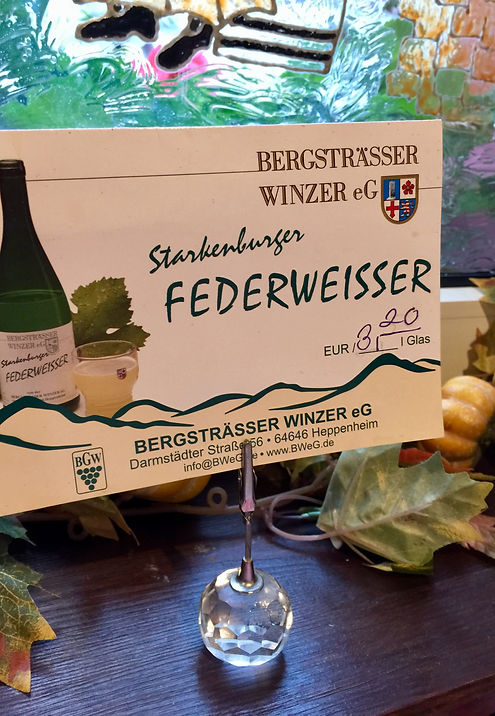
The Piroshka, a hungarian restaurant in Zwingenberg, served Federweisser, the first wine of the season. It's got Margrit daydreaming. And there's something else to dream about - a piping hot dish of Schaf's Käse (Sheep's cheese) with all the fixin's.


Walter, Margrit's brother, and his wife Sigitta, live in Zwingenberg. I remember Walter in lederhosen as a little kid when we first met in Aachen.
He later became the Commissar of Police in Darmstadt. He's now retired.
We're enjoying a delicious kuchen mit schlag sahne that Sigitta made.

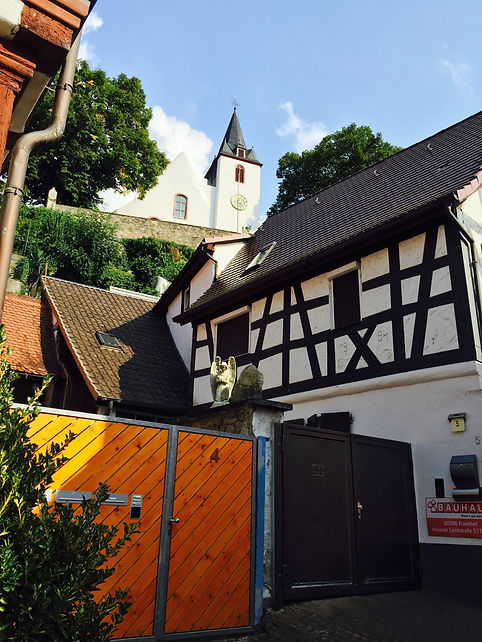
Georg and Hannelore, at right, also live in Zwingenberg. They used to live in the little haus, above right, just below the church, but then moved to an apartment near by. Georg is no longer with us.
Below is a beautiful Zwiebelkuchen prepared for us by Sigitta.


Worms am Rhine
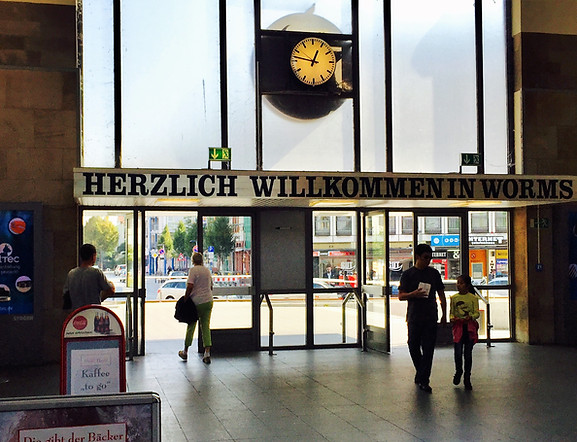

The Nibelungenlied combines two stories in Germanic tradition. The Burgundian princess Kriemhild links them. She is betrothed to the heroic Siegfried, a prince from the Rhineland at the Burgundian royal palace at Worms.
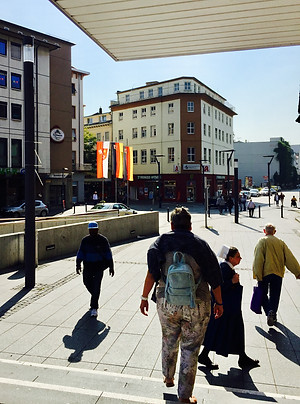


The Diet of Worms was not food, but rather an imperial council held in 1521 to decide the fate of Martin Luther and the Protestant Reformation. The resulting Edict of Worms declared Luther a heretic for his writings against the mandatory payment of indulgences and other practices fostered by the Roman Catholic Church of that day.
The promenade along the Rhine (left) is lined with restaurants.


St. Peter's Cathedral, above left, is one of the Imperial Cathedrals and among the finest examples of Romanesque architecture in Germany. Above right is the Evangelische Dreifaltigkeits Kirch or Protestant Trinity Church. The full name is Reformation Memorial Church of the Holy Trinity. It is the largest Protestant church in Worms. The baroque hall building is centrally located on the market square of the city and is now under conservation.

Luther Memorial Park
Worms was the capital of the Kingdom of the Burgundians in the early 5th century and hence the scene of the medieval legends referring to this period, notably the first part of the Nibelungenlied. Worms has been a Roman Catholic bishopric since at least 614, and was an important palatinate of Charlemagne. Worms prospered in the High Middle Ages as an Imperial Free City. Among more than a hundred Imperial Diets held at Worms, the Diet of 1521 (commonly known as the Diet of Worms) ended with the Edict of Worms in which Martin Luther was declared a heretic.

Nibelungen Bridge over the Rhine at Worms
Heidelberg on the Neckar


Although the Karl Theodor Bridge was completed nearly 250 years ago, compared to the city of Heidelberg it is comparatively young. The nickname "Old Bridge" dates from the construction of the Theodor Heuss Bridge in 1877 (then known as the Friedrichs Bridge). Since the thirteenth century there have been eight bridges on the site; the current bridge is built on their foundations. The bridge gate (Brückentor) at the south end of the bridge also dates from the Middle Ages.


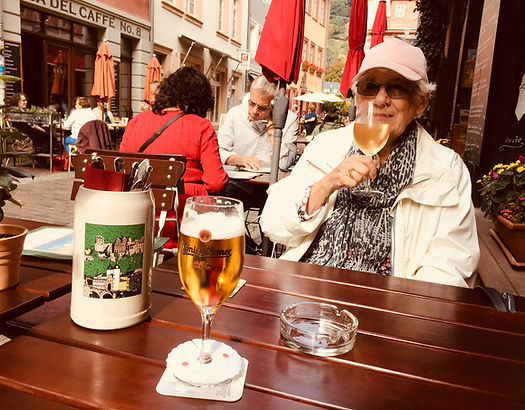


This is one of the most delicious meals anywhere. It was a schafs käse (sheep's cheese) turine with tomatoes, onions, pepperoncini and black olives. The atmosphere was great too - a little cafe near the Karl-Theodor-Brücke over the Neckar.
Every time I think about the Neckar river, I think about the story Margrit's father used to tell about a young man who introduced his father to a friend in Heidelberg, and the friend said, "that's not your father ... er sitzt am Neckar und angelt." "that's not your father ... he's sitting on the Neckar fishing."
Köthen - Margrit's home town


We went to Köthen by way of Frankfurt and Leipzig on a bullet train which they call ICE or Inter City Express.
The first documentary mention of "Cothene" dates to 1115; by 1194 it was already known as a market town, becoming a seat of the princes of Anhalt. Köthen was chartered in 1200.
For over two centuries (1603–1847) it was the capital of the independent principality of Anhalt-Köthen.


The playing fountains were really fun to watch. They're apparently computer controlled, because they do some incredible patterns and arcs at random.


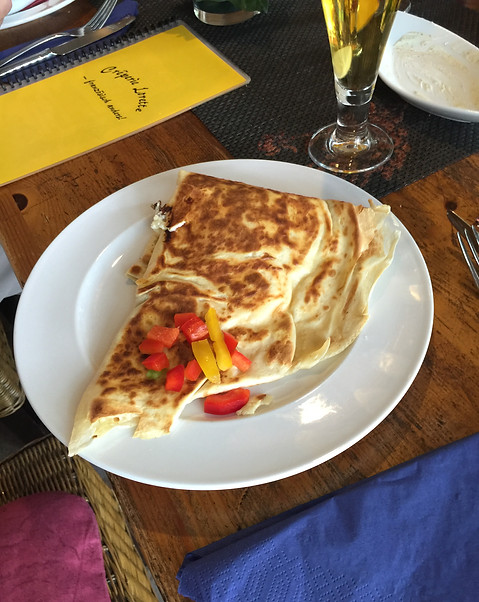
Hildegard and Otto-Walter invited us to the Creperie for, you guessed it, Crepes. Really good!


Above is Margrit's baptismal angel in Jacob's Kirche, the cathedral in Köthen, her home town.
At left, Margrit and Gabi are walking toward the church from Bach plaza.


Johann Sebastian Bach lived in Köthen while he was working for Prince Leopold. His home was on Wallstraße and was completed in 1719. When I first visited Köthen, Otto Walter Kurstedt lived on Wallstraße, just a few houses down from Bach's house. In 1723 Bach moved to Leipzig.
Bach wrote most of his secular music in Köthen, including the Brandenburg Concertos and the Well-tempered Clavier.

The Elbe River and Ferry

The Elbe Ferry is really eco-friendly. It uses only the power of the Elbe to operate. It is tethered by a cable to a pylon anchored up river. (You can just see it in this picture if you look closely) The position of the ferry and rudders are adjusted so the force of the stream pushes it from one side to the other.

A little restaurant with a terrace provides a very pleasant place to have lunch

Villa Lacus
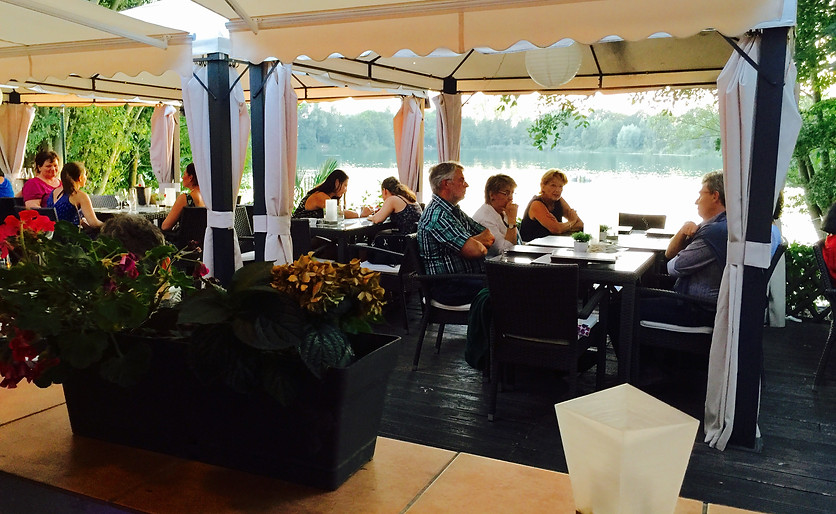
Back in Bensheim, not far from Gabi's place, is a very pleasant restaurant on a lake. Here are some pictures from there and some delicious food we enjoyed at Villa Lacus.




Our Trip to Germany 2023
The Wedding at Am Zammerberg in the Tyrol South of Munich


On to the spectacular scenery of Simmsee . . . .


Simmsee is a lake in the Alpine foothills of Bavaria, Germany. We ate in an outdoor restaurant right at the edge of the lake. The weather was perfect, but as you can see in the picture on the left, it started to rain on the opposite shore and a beautiful rainbow appeared, which surprised everyone.
Then on to Bensheim and by train to Berlin


Frank drove us through Berlin, where he now lives, and showed us all the sights. Above right is the Federal Chancellory and below right is the famous Victory Column which commemorates victories in the unification wars and inspired the addition of the bronze scupture of Victoria, the Roman goddess of victory. Below we are sitting in a restaurant on the Spree river near Frank's apartment. Barges floated by with bands playing. Delightful!


Frank took us to see the Reichstag. To get to the glass dome, we were processed in small groups so we could take the elevator to the roof. At the left you can see the entrance where groups are assembled.


The roof terrace and dome of the Reichstag Building, pictured below, offer spectacular views of the parliamentary and government districts of Berlin. Visitors to the dome of the Reichstag Building can also view the parliamentary history exhibition “From the Reichstag to the Bundestag”. Using selected images, documents and short texts displayed across twelve display cases, the exhibition tells the story of the building from its origins to the present day.


The Bundestag is the heart of the German democracy.
At right is an image in the exhibit at the base of the rotunda, showing the celebration of German unity in 1990.
German Unity Day is the National Day of Germany, celebrated on 3 October as a public holiday. It commemorates German reunification in 1990 when the German Democratic Republic joined the Federal Republic of Germany, so that for the first time since 1945 there existed a single German state.


The Brandenburg Gate is an 18th-century monument in Berlin, built by Prussian king Frederick William II.
One of the best-known landmarks of Germany, it was built on the site of a former city gate that marked the start of the road from Berlin to the town of Brandenburg an der Havel.
One block to the north stands the Reichstag building.
The gate is the monumental entry to Unter den Linden, a boulevard which led directly to the royal City Palace of the Prussian monarchs, and the Berlin Cathedral
Frank's balcony, at the right, overlooks the Spree, below.
Frank and Olga have lived there for many years, and many buildings have been built around them since they moved in.


While in Berlin we also saw many other sights such as Check Point Charley and the Holocaust Memorial, below at the left and right respectively


After Berlin we drove South with Frank to Köthen, where Margrit was born


We stayed at the Stadtscheune guesthouse near the center of town and the cathedral. Below you can see the cathedral towers from the plaza just outside the guesthouse.


Uwe drove us to to Halle for the train to Frankfurt where we then took the train to Bensheim (below).

While in Köthen we visited Otto-Walter Kurstedt's grave, below, and spent some time with his daughter, Sabine, and her husband Uwe.

Below is Margrit standing next to Sabine's table with a delightful spread of cheeses and delicious mohn brötchen and croissants. Sabine and Uwe lower left.

We stayed as usual at Gaby's place (view from balcony below left) and enjoyed some Auerbacher Rott, which is now called Region Rott, since Auerbach has been incorporated into Bensheim.


Gaby took us in her little Citroen to the Friedhof


and to Heppenheim just a few miles to the South of Bensheim.


So we said "Auf Wiedersehen!" to Germany and returned home after a very memorable experience.

Auf Wiedersehen !
My 90th Birthday Celebration
On November 27, 2024 I celebrated my 90th birthday. Niki organized a special event and invited the whole family including friends and relatives from Germany. We rented a beautiful B&B in the country near our present home in Fearrington Village in North Carolina.
The celebration included a Thanksgiving Day feast and a very special program of music, poetry and acting by all the very talented members of the family. Just click on the link below and view photos and videos from this event.