A Cotten Tale
by Joel Quentin Cotten
This is a pictorial and narrative account of my life. It is not a comprehensive history, but rather a collection of memories of people, places, events and ideas that have made me who I am.
Eden was our home

This is the old house in Eden where I grew up. The house belonged to Mrs Pound, a friend of Gramma Cotten, who gave the house to Gramma when she died. My father added to the house including a basement, dining room, kitchen, additional bedrooms and a two-car garage with a studio above where we always had our Christmases. We called it "upoverthegrage"
Half of the garage floor was covered with heavy planks. Under the planks was a root cellar in which, as the name implies, we kept root vegetables like carrots and potatoes. In about half the cellar we kept our celery. It was cut out of the garden and packed into the cellar roots and all so that it stayed alive, fresh and crisp all winter long.

On November 27, 1934 I was born in Hamburg, New York, about 15 miles south of Buffalo. We moved to Eden, about five miles south of Hamburg, before I was one year old, so I consider Eden my home. I was the fifth of six siblings, thus the middle name, "Quentin". Elmer was the oldest. We called him "brother". Then came Jane, Paul, Jack and me. We were all born in Hamburg. Nancy, the youngest, was born in Eden.
Eden was a great place to grow up. It's a small, rural town about five miles from Lake Erie, surrounded by farms and rolling hills to the East. Our next door neighbor was a dairy farmer where we got all our fresh milk. I always, to this day, love the smell of cow manure wafting in the summer breeze. The Buttses lived across the street. Kenneth Butts was a childhood playmate. He was my age and had the same birthday.
Just down the road was the Minikime's farm. They raised vegetables for the fresh markets near and far. I remember the back-breaking work of cutting cabbage all day to fill an entire trailer truck for markets of western New York. I also remember picking corn in the early morning until I wore the prints off my thumbs, or so it seemed. Minikime had two large green houses to start seedlings in the Spring. In addition to his own farm, he supplied local farmers with tomato plants and other vegetables. We transplanted tiny seedlings into trays and filled the green houses with hundreds of trays to grow in a controlled environment until they were ready to go into the fields after the last frosts.
The link below is a history of Eden with some old pictures of the town including the famous cheese factory. You will note that Sue Minekime is listed as the town historian.
http://edenny.gov/history/
In addition to working for the local farmers, we raised our own vegetables too. We had two pigs, which I treated like pets. I used to ride them and swat their behinds to make them run. Pigs are very smart. It didn't take long for them to learn to sit down when they saw me coming.
We also raised about a thousand chickens at one time. We had a two story chicken house. The chickens were Rhode Island Reds and New Hampshire Reds that laid beautiful brown eggs. I'm partial to brown eggs to this day. I used to carry buckets of water from the old hand pump in the front yard back to the chicken house over a hundred yards away and over the little creek that ran through the property. That creek would overflow in the Spring, so along it's banks we always had rich black soil for our onions and prize celery. We used to win first prize with our vegetables at the Erie County Fair in Hamburg.
Here are a number of old photos from Eden. These are the only photos that show the vegetable gardens, the two-story chicken house, and the old pump in the front yard with mother standing in front of it.
Photo at the right looks like we're all dressed up for Easter Sunday. Both Grammas are there and Betty too. Elmer probably took the picture. He forgot to say "Smile!"


Looks like a good crop of corn, tomatoes and green beans.
Hard to tell, but I think that's either Elmer or Paul with a wheel hoe cultivating the garden.
That's Gramma T in the garden and the chicken coup in the background.
Looks like green peppers and summer squash where she's standing.


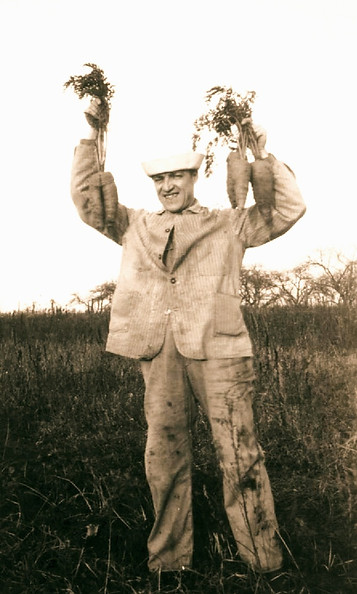
Daddy with some prize carrots, and on the left, that's me and Jack with some of the chickens.



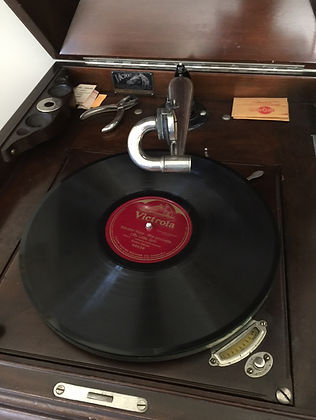
My father loved the country and his gardens. We moved to Eden for that reason, even though he had to drive every day to work at the Socony Vacuum in South Buffalo where his father was the Superintendent until his death. I never knew my Grampa Cotten, because he died before I was born. But I inherited two pieces of furniture which belonged to him. They were always in our home in Eden. One is a beautiful, old-fashioned secretary desk with two glass doors on top containing an entire set of the Harvard Classics - a liberal education in a six foot shelf of books. The other piece of furniture, which I inherited and which played a very important role in my life, is the old Victrola, and a wonderful library of old records of the great performers of the time, including Caruso, Tetrazzini, Galli-Curci, John McCormack, the Irish tenor, and the great Scottish comedian, Sir Harry Lauder. I grew up with this music and it inspired me to study voice with the intention of seriously pursuing a career in classical music and opera. More on this later.
Family Heirlooms

Pictured here are the family heirlooms I inherited - the Victrola and the Secretary with the Harvard Classics.
Also pictured below are portraits of Grampa and Gramma Cotten who originally owned the pieces, as well as two porcelain pieces painted by my father and at the right, one of my father's watercolors on the wall next to the desk.



Play these Caruso recordings:
O Sole Mio: https://www.youtube.com/watch?reload=9&v=u1QJwHWvgP8
Mia Piccirella: https://www.youtube.com/watch?v=CGeXFouBEqE
The great Scottish comedian Sir Harry Lauder sings "Stop your ticklin Jock":
https://www.youtube.com/watch?v=e9lzDEWgG4w
Amelita Galli-Curci sings La Capinera (The Wren)
In this recording there are phrases where it's hard to distinguish her exquisite coloratura voice from the contrapuntal flute accompaniment.
https://www.youtube.com/watch?v=0OyRGMyuOTk
Another unforgettable artist, whose recordings are included in the Victrola library, is the great Irish tenor of the period, John McCormack. Here he is singing "Il mio tesoro", an amazing example of breath control.
https://www.youtube.com/watch?v=wSHnxlf2DPs&list=PL59B6011A2720FE87
Above, middle frame, shows mother standing near the front porch. At her right is the old hand pump for lifting clear water from a dug well. I remember using it often.
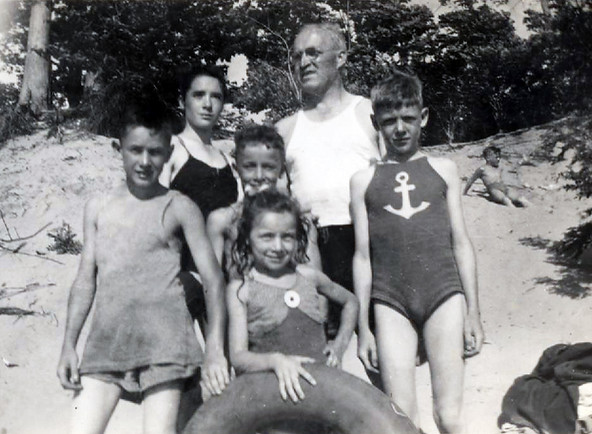
Photo at left shows us at the beach at Lake Erie. There were nice sand dunes then. I'm not sure if they are like that now.
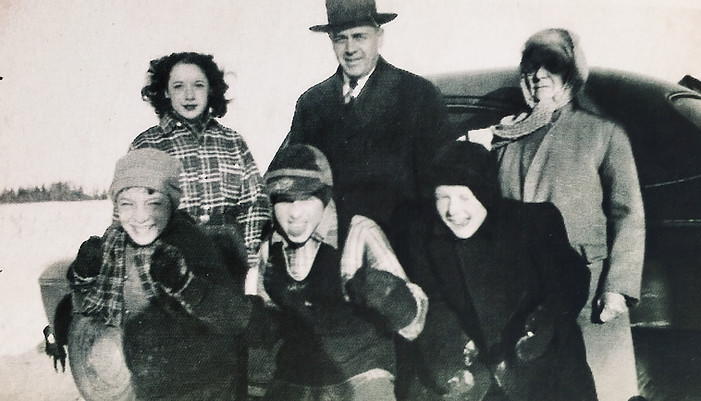

Jane, Uncle Dewey, Gramma Triftshauser and the Goof offs.

I mentioned my father's love for his home gardens because there's a memory that I want to share. Many an evening I remember watching my father polishing beautiful red tomatoes, fresh from our garden, and placing them with loving care into peck baskets so he could take them to work at the refinery and share them with his friends. An indelible image that stays with me to this day.
My father was a strong influence in my life. He was a self-taught artist and also played the violin. His paintings, both oils and watercolors, are hanging in our home and also in the homes of others in the family. I can still hear him playing Dvorak's Humoresque and the exquisite double string harmony on the violin in the living room of the old house in Eden.
It sounded like this: https://www.youtube.com/watch?v=uB8mzdO3MnI

Sadly, my father was not in good health. He suffered from terrible migraine headaches and was losing his hearing. He wore a hearing aid as long as I can remember.
My father died in 1949 at 54 years of age. His autopsy revealed a large benign tumor in his brain, which was no doubt the cause of his headaches and hearing loss.
Gramma Cotten used to tell the story of my father as a boy being injured while playing basketball at school. He was pushed against the wall and banged his head. She recalls that when he came home that day, he kept asking her the same question repeatedly, even though she had answered him each time.
We surmise that this injury may have been the cause of the tumor in his brain discovered after he died.
My father used to read to us at the kitchen table after supper. I remember him reading from James Fennimore Coopers "Leatherstocking Tales". When he read "The Last of the Mohicans" he did more than read, he would almost act the parts. His voice would change as he read the parts of Uncus or Hawkeye. He also recited stories from a book called "School and College Speaker", which I now have in my library. These were the days before television, when public oration was still an important part of education and entertainment. I particularly remember one recitation entitled "Spartacus to the Gladiators", a stirring oration in which Spartacus encourages his fellow gladiators to rebel against the Romans who have enslaved them. He cries, "If ye are men, follow me! Strike down yon sentinel, and gain the mountain passes.....if we must fight, let us fight for ourselves; ...if we must die, let us die under the open sky, by the bright waters, in noble, honorable battle." What images this congered up in my young mind.
Signor Antonio, many a time and oft in the Rialto you have rated me about my moneys and my usances. Still have I borne it with a patient shrug, for sufferance is the badge of all our tribe. You call me misbeliever, cutthroat dog, and spet upon my Jewish gaberdine - and all for use of that which is mine own. Well then, it now appears you need my help. Go to, then! You come to me and you say, “Shylock, we would have moneys.” You say so! You, that did void your rheum upon my beard and foot me as you spurn a stranger cur over your threshold! Moneys is your suit. What should I say to you? Should I not say,“Hath a dog moneys? Is't possible a cur can lend three thousand ducats?” Or shall I bend low and in bondman’s key, with bated breath and whispering humbleness, say this: “Fair sir, you spet on me on Wednesday last; you spurned me such a day; another time you called me ’dog’.... and for these courtesies, I lend you thus much moneys?”
Here's an interpretation:
My father had also performed Shakespeare as a young man. Here's a picture of him in costume as Macbeth, with leggings, feathered bonnet and sword.
One of my proudest memories in grade school was when I performed Shylock from the Merchant of Venice. My father carefully taught me the entire soliloquy to Antonio, which I performed on the stage of the high school auditorium.
My costume was an oversized bathrobe, a scraggly old white beard, that was once apparently part of a Santa Claus costume, and a bag of marbles which served as a money pouch.

Eden Central School

This is the school where I went from Kindergarten to the 12th grade; where I did my characterization as Shylock from the Merchant of Venice; where I sang Schubert's Ständchen in the auditorium, accompanied by Mrs. Patton; where I studied German in the 7th grade; and where I ran track in my last years of high school. I graduated from Eden Central School in 1953.
The Farms
I can't leave this part of my young life without mentioning two of my favorite places. Gramma and Grampa Triftshauser's farm in Alexander, NY and the dairy farm in South Buffalo belonging to Uncle Raleigh and Aunt Ethel.
Gramma and Grampa's place was on a gravel road at the time. It included a big two-story house with a wrap around veranda and steps coming down to a large concrete stepping stone at the driveway built to step up into a horse drawn carriage. I never saw it used for that purpose, because by the time I got to see it they were using a car to travel into town. Horses were still being used for farm work, pulling wagons and so forth. I remember riding on the front bench of the old wagon next to Grampa who held the reins to a team of big work horses that he called to by name. I always got a kick out of watching their big powerful haunches moving as they walked and particularly to hear them rhythmically farting as they trotted down the gravel road.
Other things that are indelibly imprinted in my mind are going down to get the cows in the evening. The cows would be waiting at the gate of the pasture. We'd walk down the road with our sticks, almost to the old one-room school house where my mother and her brothers went to school, and open the gate. The cows knew exactly where to go. We didn't need to do anything to guide them. They'd just slowly walk together up the road to the barn, through the doorway in the basement and right into their own stanchion as though their name were written on it. We'd then walk between the cows and close the stanchions. They were the type that permitted the cow to move its head up and down to eat its grain and hay, but the slats, when closed, were close enough together so the cow could'nt get its head back through. I was too young then to milk the cows, but not too young to enjoy warm, fresh milk right from the spigot. There was an old tin cup hanging from a nail on the wall of the barn. I would hold the cup and the guy milking the cow would fill it with warm frothy milk right from the teet. This would be frowned on today with all the concern with sanitation, pasteurization and all that, but it tasted great and never did me any apparent harm.
Gramma's gardens were uniquely beautiful. I particularly remember the old fashioned Hollyhocks. We used to pick the young seed pods while the seeds were still soft, white and packed in a neat circle so we could easily eat them. There were also red currants and gooseberry bushes. At one time gooseberries disappeared from western New York. I later learned that they got some kind of disease and were destroyed by the Ag people so the disease wouldn't spread.

Grampa and Gramma Triftshauser's farm in Alexander, New York
The concrete step at the driveway was built to step up into a horse drawn carriage in the days before cars.
The concrete post had an iron ring attached for holding the horses reins.

Gramma and Grampa Triftshauser on the farm

Nort, Dewey, mother, Grandma and Grampa
Walt and George holding the dogs
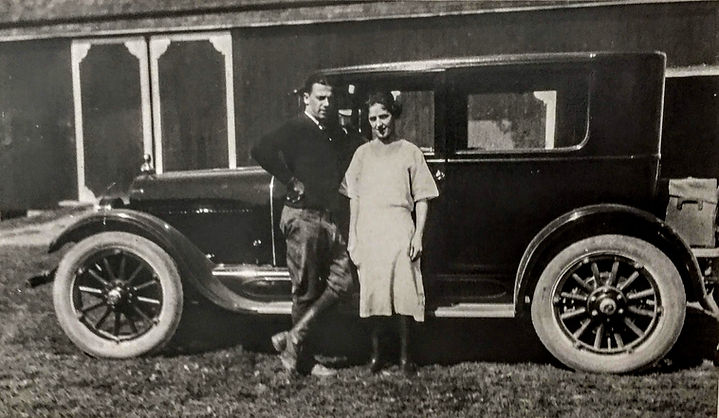
Uncle Dewey and mother and Dewey's new Buick
More pictures of the Werners & Triftshausers, including Great Gramma and Grampa Werner in Drachenbronn, Germany: https://jqcotten9.wixsite.com/jqcotten/family
Another fun place in my young life was Aunt Ethel and Uncle Raleigh's dairy farm. I remember going there for Thanksgiving all together in the old Chevy and singing on the way. Aunt Ethel would always have games for us to play, like a treasure hunt for things hidden all over the house, or drop the clothes pin in the bottle. We'd just stand holding a wooden clothes pin up to our nose and try to drop it into the narrow opening of a milk bottle. The one who got the most in out of a certain number of tries would win a prize. That was great entertainment in those days. The meals of course were sumptuous - turkey and stuffing and all that goes with it. We all sat down to the huge table together and sang the blessing - "We gather together to ask the Lord's blessing .... sing praises to His name, He forgets not His own." I don't remember all the words, and at my age, I probably didn't understand half of them anyway.
Sadly, both of these farms of my fondest childhood memory are gone. The Triftshauser farm burned down and the New York State thruway now runs right over the place where uncle Raleigh's farm used to be. The only thing that remains is our memories and a few old photos.

Uncle Raleigh and Aunt Ethel's farm

In the driveway at Uncle Raleigh and Aunt Ethels
The Pine Grove in Eden
As I move on with my narrative and then briefly set it aside, my mind still dwells in the time period that I'm writing about and inevitably I remember things I should have mentioned. This is one of them. We lived in an area with farm fields and woods nearby. There was a beautiful, peaceful pine grove at the edge of the woods. When you entered the grove it was like entering an empty church. The ground was covered with a thick carpet of pine needles and it was serenely quiet. We would sit down with our backs against a tree trunk and not say a word. After a few minutes the little birds that were in the branches of the trees and were silent when we intruded into their cathedral, finally started again to chirp and sing. It was a serene moment one can only experience in nature.
We used to camp out near the pine grove where there was a marshy area with a little pond. We built a leanto out of pine branches and started a nice fire in a fire pit that we lined with stones. The fire attracted some large frogs from the pond. They came hopping right up to us. Little did they know that they would be part of our meal that evening. We stabbed them with our trusty hunting knife and cut off their hind legs. It's amazing how easy it is to skin a frog's leg. You just pull the skin right down over the toes of its feet, like taking off a pair of pants. The flesh of the frog's leg is pure white and makes a tasty treat fried in butter. To supplement the feast, we picked fresh sweetcorn from a farmer's field near by and roasted it in the fire. We left the husk on and just shoved it under the hot coals of the fire for a few minutes until the outer husk was charred. When you peeled back the husk the steam would rise and you could smell the corn that was steamed in its own husk. We left the husk on and used it as a handle to rub the ear of corn over the block of butter we had brought with us. A dash of salt, and you feast on the most delicious corn on the cob you can imagine. Frogs legs and fresh corn on the cob. A delicacy fit for a king and almost impossible to replicate without going back to that place...if it still exists...which I doubt.
There was also a large irrigation pond back by the woods which the farmers used to irrigate their fields. As a matter of fact, I learned to swim in that muddy, old, frog, snapping turtle and leach infested water hole. The fields in that area were separated by irrigation ditches which were lined with weeds and natural growth and made an ideal habitat for muskrats. They would dig their burrows into the sides of the ditches, usually below the water level to prevent access by other animals. My brother Jack trapped muskrats and other animals for their pelts. The pelts were the best in the late Fall and Winter so he'd set out his traps then. I didn't particularly like the idea of trapping animals, but Jack was my brother and I thought he might like some company so I'd go with him from time to time. We got up early in the morning and trudged through the snow to check on the traps. The traps were set under the water at the entrance of the muskrats burrow. In the Winter we'd have to chop through the ice and feel around to see if there was anything caught in the trap or if the traps had been tripped and needed to be reset. Sometimes we just found a leg in the trap but no muskrat. They would chew off their own leg to get out of the trap.
We brought the ones we caught back home, and in the cellar we skinned them. The skinning was done by hanging the muskrat upside down by its hind legs, cutting completely around each leg just where the fur begins, and then making a straight cut between those two cuts. You could then start pulling the pelt down over the muskrats body and head, cutting along the way to remove the skin from the body and then making a final cut around the wrists of the front legs. The pelt would then come off in one piece. We then pulled the pelt over a stretcher, skin side out, and rub the skin with corn meal or saw dust to remove the excess fat and oil from the skin. After they dried for a week or so they were removed from the stretcher and were ready to sell. Some guy would come out from Buffalo to buy the pelts for the furriers who made women's shawls and coats. The price for a pelt after all the work involved in trapping and preparing them was, if I recall, anywhere from 5 to maybe 7 or 8 dollars for a really prime pelt. I wonder what that guy sold them for?
Jack also set traps for mink and ermine in the woods. Ermine was simply a weasel in winter whose pelt has changed from a dark brown to pure white for camoflage against the snow. Trapping mink and ermine was a more complicated process because they were smarter. You had to find the animal trails through the woods, places that they frequented. Then you look for a dead fall - a branch or tree that has fallen across the trail, and you place the trap behind the dead fall. But the trap is buried just below the surface and sand sifted over it being careful not to obstruct the movement of the pan which the animal steps on to trigger the trap. You then place local material, leaves and such, so it looks natural. Then you disguise your scent by putting a few drops of animal musk from a bottle that is purchased from a trapping supply company. All that to catch a couple ermine or mink. There really weren't that many around.
It was quite an accomplishment.
The Boy Scouts
Those were the days when we would stand with three fingers raised and recite a credo which gave meaning to our young lives. “On my honor, I will do my best to do my duty to God and my country, to obey the Scout Law, to help other people at all times, to keep myself physically strong, mentally awake and morally straight.” I did go on later in my life to help other people less fortunate than I, all over the world. Who knows, maybe the recitation of that oath, had something to do with my later interest in working with the Agency for International Development.
USAID, founded by John F. Kennedy, is the world's premier international development agency, providing development assistance to help partner countries on their own development journey to self-reliance, and helping to lift lives and build communities around the world. It was interesting work and a lot of fun.
Obeying the Scout Law, on the other hand, is kind of something you work on your entire life. “A Scout is trustworthy, loyal, helpful, friendly, courteous, kind, obedient, cheerful, thrifty, brave, clean, and reverent.”... and really nice, too ... I might add.
Mr. Engelhardt, Paul and Billy Engelhardt's father, was the scout master of our troop in Eden. Cub scouts had "dens", but boy scouts were organized in "troops", remember?. We had meetings uptown in the old Town Hall next to the Fire Station. The Town Hall had a large assembly room with a stage. I think the large room was also a gymnasium. For special occasions when parents and guests were invited, we had to set up folding chairs on the gym floor. There were no permanent seats.
I remember performing skits in the auditorium. Once I played Christopher Columbus, or Kritsaper Colum, with a thick Italian accent. It's hard to write an accent, but it went something like this: "Kritsaper Colum he wassa born in It-aly. Hissa fadda, he run a peanut an a banana stand and he make a lossa da mon. One day Kritsaper he come to hissa fadda ... he say fadda... Ima gonna go fine a new worl for It-aly ....." and so on. Anyway I had them all in stitches .... but you had to be there, as they say.
Another short skit was with John Zulick. We did our famous typewriter skit. You see, John was a tall kid with a very prominent nose. He stood on the stage with his arms crossed, which served as the typewriter keyboard. I stood in front of him and started typing on the "keyboard". John made the typing sound ... click, click, click ... and jerkily moved his head like the carriage of the typewriter. Then he made a ding sound and I grabbed his nose and returned the carriage. The audience broke up! Short skit, but it "brought the house down" as they say in theater parlance.
One Summer the boy scouts went to camp Ti-Wa-Yee. I can't remember exactly where it was, but it couldn't have been too far from Eden. The most memorable thing was our orientation. The camp had a big Polish cook who prepared all the meals and gave his schpiel about the mess hall. I'll never forget when he got up in front of all the scouts and explained: "Youse guys can have all you wanna eat. You can have foists, seconds and even turds. I usually quit with seconds.
And then there was the camping trip with Mr. Spencer, our science teacher. We called him Beaky, because he had a big nose. However, when it was time to go back home, after a few days in the woods, Mr. Spencer tried to get us to stop calling him Beaky. So for the last couple days, if we inadvertently called him by that moniker, he'd have us bend over and he'd give us a swat with a broom. I tried to remember Mr. Spencer's admonition, but inevitably let "Beaky" slip out when I addressed him. O.K. Cotten, bend over! He gave me such a whack, that the broom handle broke. Everyone had a good laugh at my expense, but it really didn't hurt that much.
California bound
Again, reviewing what I've written, I noted a glaring omission - my sister Jane. Of course, I'm writing about myself, but there were things in her life and untimely death that are certainly a part of the Cotten Tale. We were close as kids and I remember doing plays together for the relatives. Jane studied art in Buffalo at the Fulbright Art School, and it was there that she met Dick, who was also an art student at the time. They got married and moved to California.
I don't remember exactly when, but it was some time after my father died, that we all - Paul, Jack, Nancy, I and mother - squeezed into Elmer's little Nash Rambler and headed west - California bound. In spite of the crowded conditions, the trip was an amazing adventure. One of the places we passed through, that I remember in particular, were the Black Hills and the Badlands of South Dakota. From the four faces carved high on Mount Rushmore and the Cathedral Spires of Custer State Park to the wondrous caverns of Wind Cave, from the otherworldly Badlands in the east to Devils Tower in the west – the Black Hills are home to many truly monumental places.
I also remember Salt Lake City, Utah. The Mormon Tabernacle and the salt flats. One of the things that stuck in my mind was the cleanliness of Salt Lake City and the white porcelain drinking fountains on the sidewalks.
Yellowstone National Park in Wyoming was also amazing. At the time there was only one big lodge near the Old Faithful geyser. We arrived late in the day, and the lodge was full, so we hunkered down in the car for the night in a parking lot not far from the geyser. Old Faithful was true to her name. Every hour on the hour, all night long, we were awakened by the roar of that powerful geyser as it blasted into the sky.
Approaching the Rockies to the continental divide was also memorable. The little Rambler started laboring as we climbed. We couldn't imagine why, because, strangely, out the front window it looked like only a slight incline, but when we looked out the back window we could see that the road dropped down sharply. It was definitely an optical illusion. We stopped along the road, high in the mountains, and I remember running up a steep slope to a snow drift that had not melted even in mid-summer. I made a snowball and brought it back to the car.
On we went to the west coast. The next place I remember was San Francisco and China Town. I love seafood, and I remember that we ate in a restaurant on Fisherman's Wharf where I had a platter of seafood I'll never forget. My plate was piled high with a salad of shrimp, prawns and fish of all kinds. Boy was that good!
So it was on down the coast to Los Angeles. Jane and Dick were living in Venice near the beach at the time. Nancy believes that Dale had come into the world, and was about a year old then. I think Dick worked for Disney for a time, but if I'm not mistaken he was running a hardware (Western Auto) store at the time we visited them. The name Ampreneer sticks in my memory. We spent some time there and then headed back home. We took the southern route back and saw such places as the painted desert and the petrified forest. That was a lot of driving and I think Elmer did most of it.
At one time Jane and Dick lived in Bradford, Pennsylvania and we visited there. Margrit had just arrived in the U.S. from Germany. She thinks that the first time she met Jane was in Bradford. Jane and Dick also lived for a time near Dallas in Greenville, Texas. Jane died from melanoma that was not detected and treated early enough and metastasized to her internal organs and finally to her brain, which was fatal.
Canada
We had relatives in Canada and used to drive up in the Summer for a week or so. The relatives were from my father's side of the family - the Robertsons and the Burnhams. I don't remember exactly how they are related, but I do remember the places and some of the people quite well. I do have some old photos of May Burnham with mother and of my father standing next to Uncle Wilson holding a big pike he had just caught. Uncle Wilson lived alone in a little old house in Fallbrook, Ontario, north of Perth. To get there, we drove East along Lake Ontario and North across the St. Lawrence. I can't remember exactly where we crossed - probably North of Watertown at Alexandria Bay. We then headed North to Perth and on up to Fallbrook. The trip would take a good six hours or maybe more in those days - in the late 1940s. The first section of the New York State thruway, between Utica and Rochester, wasn't completed until June, 1954.
Fallbrook was a nice little town in my recollection. A river ran through it and the main street was unpaved. Uncle Wilson's house was near the river and we drove into his driveway just after crossing an old steel girder bridge, if my memory serves me. Uncle Wilson was an old man in his 90s. That's old for a boy my age, around 12 or so at the time. The younger Burnhams lived in a newer house in another part of town. The drive from Fallbrook up to Robertson's Lake was on a single track dirt road in those days so it probably took an hour or so to get there. Now it's about half that time according to Google Maps.
We stayed in an old, one room cabin right on the lake. The Robertson's, after whom the lake was named, lived on a ramshackled farm up a steep hill behind the cabin, with a nice sweeping view of the lake. Robertson's lake was like heaven then. There were almost no other cabins on the lake and no noisy motor boats, just canoes and row boats. It was so tranquil, especially in the evening when you could hear the loons calling. The lake was long and narrow. From the cabin you could see the huge boulders and the woods on the opposite shore. I remember picking wild blueberries and strawberries that grew around the rocks at the edge of the woods. I used to paddle our boat into the lagoons and just lie still and watch the little fish swimming in the crystal clear water beneath the boat.
There was a square structure near our cabin built like a log cabin, but without a roof. In the winter, the locals would saw huge blocks of ice out of the lake and put them into the log structure and then fill it with saw dust. The saw dust would act as insulation and keep the ice frozen all Summer long. That was our ice box. When we caught a lot of fish, we'd wrap them in newspaper, and put our name on it, climb into the ice box, dig into the sawdust down to the ice, lay the fish on the ice and cover them up. Worked just like a refrigerator, but a lot more fun.
Life in those days in that part of the world went along at a slow pace. I often tell the story about the time we went to Canada, sometime after my father died. We stopped at the Burnhams in Fallbrook to say hello. Meryl had built his own house and, as a matter of fact, he built a lot of the tools he used. He even forged the blades he used to shape the molding for the doors and windows of the house from old steel files. As we were about to leave, he asked us to help him with something. He was building a trailer for a friend, and had the wooden box of the trailer sitting on some saw horses in the yard so he could work on it. He asked us to help him turn it over so he could work some more on it. We helped him with that task and then said goodbye and got ready to leave. As we walked to the car, he said goodbye and then added, "when you guys come up here again next year make sure you stop by and help me turn this thing back over." I think he was serious. We continued to go to Canada from time to time after my father died, but more and more people discovered the lake as a vacation site and it changed. More houses and finally motor boats. I preferred the good old days.
Chautauqua
Summer vacations in Chautauqua are another fond memory. Chautauqua Institution is a community on the shores of Chautauqua Lake in southwestern New York state only a few hours drive from Eden. One season the whole family went. We rented a house and enjoyed all the sporting and cultural events offered there. In those days it was a protestant institution and nationally renowned scholars and clergymen were invited to preach and give lectures. They would give the Sunday sermon in the huge amphitheater and then lecture in other open air venues during the week.
My father was in Chautauqua with Gramma Cotten when he died of a cerebral hemorrhage in the Summer of 1949 when I was just 15 years old.
I continued to go there however to take advantage of the rich culture it provided. Mother helped me advance my interest in singing by paying for voice lessons there one Summer. I studied briefly under Evan Evans, a renowned vocal coach from the Julliard School for the Performing Arts in New York City, who offered lessons in Chautauqua during the Summer.
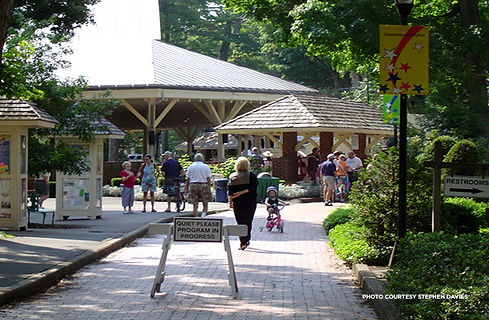

Above are pictures of the Amphitheater in Chautauqua. It was the central venue for the Sunday worship service, and for lectures, symphonies, and cultural events of all kinds.
Below is the scenic waterfront of Chautauqua Institution. The Institution, originally the Chautauqua Lake Sunday School Assembly, was founded in 1874 as an educational experiment in out-of-school, vacation learning. It was successful and broadened almost immediately beyond courses for Sunday school teachers to include academic subjects, music, art and physical education.

During this period I was also interested in religion and philosophy and was attracted to Nels F.S. Ferré, professor of philosophical theology at Vanderbilt University School of Religion, who was lecturing in Chautauqua at the time. He spoke on Sunday as usual and then gave a series of lectures on a new book he was writing, but which was not yet published, entitled "The Sun and the Umbrella". The book was published in 1953, so the event of which I speak was some time prior to that. I graduated from High School in 1953, so the lectures were probably in the Summer of 1952 and I was around 17 years of age. I had not yet discovered the Baha'i Faith which teaches the concepts of progressive revelation, the oneness of mankind and unity in diversity, but I was already grappling with the problem of denominationalism within the Christian Church. How could a message of love and unity result in so many divisions?
Anyway, there I was at age 17, or there abouts, listening to Nels F.S. Ferré in Chautauqua telling his parable about these folks who were living in a barn with no windows, when someone came in from outside and told them about this amazing light outside. He told them they should come out of the darkness of the barn and see the light for themselves. They had been told about the light and they had formed various groups who thought about the light in different ways but couldn't quite agree on what it was. Some were afraid to venture out of the barn, but others, more venturesome, decided to build themselves umbrellas, and went out of the barn into the sunlight ... under their umbrellas.
For me, at the time of the lectures, the umbrellas were the variuos Christian denominations and the light was God. Unfortunately, for Nels F.S.Ferré, the light was the universal Church of Jesus Christ and he did not go beyond it. Today, as I see it, the umbrellas represent the various religions of the world and the light is the knowledge of the oneness of all religions and the understanding that revelation is progressive. We must come out from under the umbrellas of religious orthodoxy and dogmas that divide us, into the light of unity.
I had not yet met the guy who led me out of the barn. But it was not long after Dr. Ferré got me started thinking, that I met Fran Czerniewski. He was about my age. I can't remember the circumstances, but he was the first person to tell me about the Baha'i Faith. One of my best friends in Eden at this time was David Palmberg and we studied the Faith together. David and his family were Christian Scientists. They were a poor family and lived in a ramshakled house up the hill on East Church Street. Another close friend was Billy Englehart. He belonged to the United Church of Christ and went on later to study theology at Eden Theological Seminary in St. Louis. He married Judy Sherman and I sang for their wedding. Unfortunately, Billy was killed in a motorcycle accident. Judy remarried and we sort of lost touch. But I'm getting ahead of my story again.
While I was still in High School I started running track. I was a pretty good sprinter and ran the 100, 200 and relay. I won my share of events competing with other schools in western New York, and after an especially successful meet was elected co-captain of the team by my peers. Quite an honor.
I grew up as a Methodist. We went to the Wesleyan Methodist Church up town on East Church Street. We lived on West Church Street a little over a mile to the West so we could walk to church and often did. Across the street from our church was the Baptist Church. Our next door neighbors, the Buttses, were Baptists. On South Main Street was a United Church of Christ, and later on a Catholic church was built a little further down near the Kazoo factory.
When I think back on our little town, it didn't have any particular claim to fame, except the Garden of Eden, of course. That was the name of the saloon uptown. We did have a great little cheese factory, built by a Swiss family, the Rupps, and...Eden was the place where the Kazoo was invented. We all played the Kazoo at one time or another, but you didn't need to know much theology to do that. The Kazoo did more to unite us than theology ever could.

This is a page from the 1953 Eden Central School Yearbook, the "Embers".
I'm kneeling in the front row, second from the left, with the track and field team in which I participated.
The comment below the picture mentions my performance in the sprints.

This is the famous Kazoo factory. It looks a little more spiffed up than in my day. It's now a museum and gift shop, but they still make the Kazoo here.


Vocal Studies with Jolanda Aprea-Patton
About this time my sister Nancy was learning to play the violin. She started taking lessons in Buffalo with Mr. Rantucci, the first violinist with the Buffalo Philharmonic. I was still interested in singing and learned about an Italian vocal teacher in Buffalo through Mr. Rantucci. Her name was Jolanda Aprea Patton, married to a nephew of General Patton, and as it turned out, an amazing teacher of the Italian Bel Canto method. She had three degrees from the Conservatory of Music in Naples - in piano, voice and voice culture and she had a beautiful soprano voice herself. I couldn't have fallen into better hands for someone seriously pursuing a career in classical music and opera.

Jolanda Aprea Patton formerly of Leonia, NJ, died at home in North Bergen, NJ, on May 22, 2004. She was born in Naples, Italy in 1911 to a family of painters and musicians. She grew up in Italy through two World Wars and the Great Depression. She went to America after the war to wed the now late Lowell Russell Patton, Jr., a nephew of General George S. Patton of WWII fame.
As a singer and vocal teacher she was always compelling. Those who knew her were deeply attracted and affected by her astonishing passion for life. Her life was her art. She now rests in Naples, Italy where she was born.
The Arion Award was established in 1948 to give national recognition to junior and senior class members chosen by their schools for outstanding achievement in music.
Arion Award
for Music

In my senior year at Eden Central School I was making good progress with Mrs. Patton and was asked to sing at an assembly in the school auditorium. Mrs. Patton came to Eden to accompany me on the piano. I remember the occasion well because I had to personally arrange to have the curtains opened before I started. Mrs. Patton sat down at the piano which was placed at the edge of the stage in front of the main curtain. I stood next to her and prepared to sing when she whispered to me to have someone open the curtains. She of course knew, as an experienced performer, that the heavy velvet curtains would absorb the sound of my voice and hamper its projection into the auditorium. So I walked to the side of the stage and asked someone to open the curtains. I then returned to the piano and prepared to sing. The whole incident impressed on me just how little the people at school knew about theater and sound management. Mrs. Patton started to play and I sang the German lied we had practiced - Schubert's "Ständchen". I regret that no one bothered to record the performance. Anyway, the singing went well, thanks to Mrs. Patton, and the performance was well received.
Since I don't have a recording of my own, here is Jussi Björling, the great Swedish tenor, one of my favorites, singing Schubert's "Ständchen":
https://www.youtube.com/watch?v=S1epqEHoVE8
For those interested in the translation and history of this beautiful German Lied you may wish to explore these websites:
Here's the translation:
https://www.oxfordlieder.co.uk/song/988
Here's the history:
https://en.wikipedia.org/wiki/Schwanengesang
I “almost” heard Jussi Björling sing at Kleinhans Music Hall in Buffalo. Well, I bought the ticket and went to Buffalo for this highly anticipated performance, only to learn that Björling could not make the performance and that George London, a Metropolitan bass-baritone, would sing instead. I learned later that Björling was an alcoholic and didn't show up that evening because he was drunk.
If it were not for Mrs. Patton, there would be no evidence at all that I ever did sing. Thanks to her, during the course of my studies with her, we went to a small recording studio in Buffalo and recorded two antiqua aria, "Danza Danza Fanciulla" by Durante and "Gi'al Sole dal Gange" by Scarlatti. The reason for making the recordings was for me to be able to better hear my voice in order to improve the way I was singing. These recordings, made when I was just 20, are now the only evidence I have that I studied voice and sang. They started out on a 78 rpm disc, were eventually transferred to casette tape, and are now in digital form on YouTube. Just click the links below to play.
Danza Danza Fanciulla: https://www.youtube.com/watch?v=_kpfjyv05qA
Gial Sole dal Gange: https://www.youtube.com/watch?v=5q8gjtlLNUQ
I received the Arion Award for music in my senior year at Eden Central School.
I graduated from high school and continued my education at the University of Buffalo (UB). I pursued a BA degree majoring in Philosophy and continued studying voice outside of school with Mrs. Patton. I also continued studying the Baha'i Faith. I attended "firesides" at the homes of Baha'is in Hamburg and studied with several of the families there. Because of my interest in philosophy and mysticism at the time, probably due to the loss of my father and all the questions that raised in my mind, one of the first Baha'i books I studied was "The Seven Valleys", a mystical work by Baha'u'llah. The works of Baha'u'llah are voluminous and I studied several during this period.
I studied the Faith for several years. The experience was truly an intellectual and spiritual adventure for me. One of the most amazing aspects of the Faith was its relative newness. It started in 1844 in Shiraz, Persia with the declaration of Siyyid Ali Muhammad, the Bab, which in Persian means the Gate. He was accepted by some as the Qa'im, the promised One of Shi'ah Islam. His life was short and tragic. His purpose was to announce the advent of "Him Whom God shall make manifest", to an entrenched and fanatical ecclesiastical regime. But, it's not my intention here to recount the history of the Baha'i Faith, for it has been well documented by many, including Shoghi Effendi, the grandson of Abdu'l Baha, who was the eldest son of Baha'u'llah, the founder of the Baha'i Faith himself. Shoghi Effendi's seminal work, entitled "God Passes By", first published in 1944, is a comprehensive history of the Faith, which is presently available as an eBook for anyone to study. Here is a link to a Baha'i site where you can download free Baha'i ebooks, including "God Passes By" by Shoghi Effendi: http://free-ebooks.bahaibookstore.com/
Yes, that's how close the Faith is to us chronologically. Shoghi Effendi was still living at the time I started studying the Faith. As a matter of fact, I wrote him a letter with some questions about my search. His wife Rúhíyyih Khánum Rabbani, answered the letter in his name. At the time I was contemplating a period of withdrawal and contemplation to "find myself" so to speak, but Shoghi Effendi's counsel was basically that this is not the time to withdraw from the world, but rather to be actively engaged in the process of unifying a divided world through dissemination of the principles of the Faith and assisting in building the institutions adumbrated in its teachings.
Some day the world will be like this: https://youtu.be/nS1RBSrOGng
I have produced a number of video documentaries about the Faith, including "What Hath God Wrought", which tells the story of the Faith from the point of view of the Adventist movements within both Christianity and Islam. Here is the link to the YouTube site where you can view all of my documentaries. To play any of the documentaries in their entirety, please click on Play All, following the title, so that all episodes play in the proper sequence:
https://www.youtube.com/user/jqcotten
I have recently come across a Baha'i website which may be of interest to the reader. It's called Bahaiteachings.org and a video by David Langness called Nazi Germany: The untold story of the Baha'is. Here's the link:
https://www.youtube.com/watch?v=lZMzitl6GmE&t=12s
Another more recent presentation made possible by today's zoom technology.
Promoting the Oneness of Mankind during the Jim Crow Era:
https://drive.google.com/file/d/1eJHMANS8DN6fBWGGtqDxjSec8hHTmnXY/view
I made my declaration to become a Baha'i on March 18, 1956 in Hamburg, NY along with my friend David Palmberg. As their is no clergy in the Baha'i Faith, the Local Spiritual Assembly of Hamburg officiated. Whereever at least nine Baha'is reside, in a local jurisdiction, an official organizational entity called a Local Spriritual Assembly is created. David and I were the first and only Baha'is in Eden at the time, so we made our declarations in Hamburg. One becomes a Baha'i by personal declaration after the age of maturity which I believe is 18. I was 21 at the time. Unlike the Christian Faith, where you can be baptised into the church at infancy, to become a Baha'i one must make an independent declaration as a mature person.
My experience in New Jersey and New York City
Before my final year at UB, Mrs. Patton moved with her family to Elizabeth, NJ. Mr. Patton worked for Pfizer Pharmaceuticals and had to move there for his work. So, instead of finishing my final year for the BA at UB, I followed Mrs. Patton to NJ to pursue my first interest - classical music and voice. Mother helped me buy a used Plymouth coupe which I drove down to Elizabeth. I don't remember how I learned about the Thigpens, but I ended up renting a little room in the attic of their home. The Thigpens were a middle-aged, black, Baha'i couple, who were the most gentle and loving couple I had ever met. The room was very inexpensive and the Thigpens even let me share their kitchen. I got a part-time job in a local Super Market, stocking shelves and that sort of thing.
I don't remember exactly how I met Sam Jackson, but we became close friends. He was a black Baha'i - taller and a little older than I was, if my memory serves me. He had just gotten a new car, and he would pick me up and take me to different Baha'i events whenever I could get away. One evening he took me to Teaneck, to visit Mrs. Kinney, an elderly Baha'i who had met Abdu'l Baha when he visited the U.S. in 1912. Teaneck, N.J. is also the town where the famous Cabin is located, also visited by Abdu'l Baha. Vaffa Kinney lived in a modest home in a quiet residential part of town on a lovely tree-lined street with concrete curbs and a sidewalk. The houses sat well back from the street with manicured lawns. Sam pulled his car up to the curb a few houses down from Mrs. Kinneys. Sam and I got out of the car and started walking down the sidewalk together. This is when I learned that racial prejudice is not only found in the South, but also in Teaneck, New Jersey. A woman was sweeping her porch on the house where we had parked. She hurried down her sidewalk to the street loudly complaining all the way that we couldn't park there. I stood there, somewhat taken aback, while Sam confronted her and calmly explained that the street was a public thoroughfare and it was perfectly OK to park where he did. It soon became disgustingly clear to me from her reaction that her concern was not that we had parked the car there, but that a black man and a white man had occupied it. We left her standing there holding her broom stick, and walked down the sidewalk to Mrs. Kinney's. It was a wonderful "feast" that evening with a small group of local Baha'is sitting around Vaffa Kinney and listening to her stories about Abdu'l Baha, the eldest son of the Founder of our Faith. The "feast" was what we called Baha'i gatherings, usually in the homes of Baha'is. It was a spiritual feast. The Faith was still young and every town did not have its own "church" or gathering place.

Abdu'l-Baha at a gathering in Teaneck, NJ in 1912.
Vaffa Kinney is pictured at the upper right.
Here is a recent message on Advancing World Peace by the Universal House of Justice of the Baha'i Faith. Just click on the PDF icon to read.
The link below is a documentary entitled "Glimpses of a Hundred Years of Endeavor". It was produced by the Baha'i World Center for the Centenary of the passing of Abdu'l-Baha.
https://www.youtube.com/watch?v=4MsMfnkd6_I
Elizabeth, New Jersey was only about 30 minutes by car from Teaneck and just a little over an hour by bus from the Port Authority terminal in New York City, so I could get to the city whenever I wanted. I soon learned what a great city it is. During the time that I was studying voice with Mrs Patton, I was able to enjoy the inspirational cultural life that New York City had to offer. I got tickets to the old Met for several memorable performances. Unfortunately I could only afford tickets high up in the Gallery for standing room only. I was so high up and to one side that I could only see half of the stage for the matinee performance of Maria Callas in Donizetti's "Lucia di Lammermoor". Luckily, the accoustics were great in the old theater, and her magnificent voice carried beautifully into the Gallery.
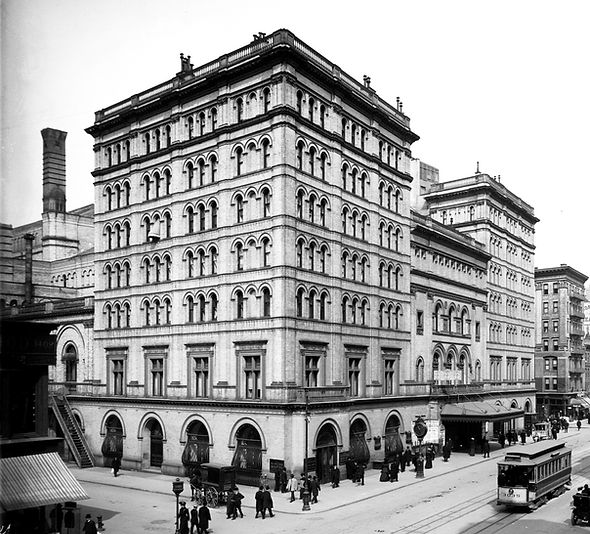
The Metropolitan Opera House was located at 1411 Broadway in New York City. Opened in 1883 and demolished in 1967, it was the first home of the Metropolitan Opera Company.
Below is the beautiful concert hall where I heard some of my first live opera performances.

At another time I managed to get tickets for the entire Ring cycle, Wagner's "Der Ring des Nibelungen", Das Rheingold, Die Walküre, Siegfried and Götterdämmerung. I had bought the DVD of Die Walküre, performed by Lauritz Melchior and Lotte Lehman and played it often. That rendition is one of the greatest. So I was a little disappointed with the live performance at the Met. Wolfgang Windgassen was no Lauritz Melchior. Oh well, you can't have everything.
I used to sing one of the beautiful arias from Die Walküre entitled "Winterstürme", during my lessons with Mrs. Patton. This rendition is by Melchior from the legendary 1935 recording with the Vienna Philharmonic under Bruno Walter, which is the same version I had on DVD. About 3 minutes in you'll hear Lotte Lehman. The quality of her voice was very similar to that of Mrs. Patton.
Part 1: https://www.youtube.com/watch?v=7XQASPDdGQE
Part 2: https://www.youtube.com/watch?v=mS-HYMAW7hk
The story of Die Walküre:
https://en.wikipedia.org/wiki/Die_Walk%C3%BCre
Feodor Chialiapin
Another memorable experience in New York City during that period happened when I came across an announcement in the local paper about an evening with Chialiapin. I love the sound of the great Russian basso profundo, Feodor Chialiapin, who sang at the Met during Caruso's time, so I noted the time and the address and made plans to go. When I arrived at the address, I was surprised to see that it was a private townhouse. I walked up the front steps of the brownstone and opened the front door which entered into a foyer. If I recall the apartment door was numbered, so I knocked and was greeted by a woman who introduced herself as the daughter of Feodor Chaliapin. She invited me into a small living room where a few other people were gathered and she explained that she would play some recordings and talk about her father. It turned out to be a delightful evening. Only in New York.
https://en.wikipedia.org/wiki/Feodor_Chaliapin
Feodor Chaliapin sings Anton Rubinstein's: Persian Love Song (recorded in 1931)
Listen for the exquisite falsetto at the end of the song.
https://www.youtube.com › watch
So there I was, absorbing the cultural life of that exciting metropolis, and studying voice with a truly great teacher, in hopes that I might one day be a part of that life myself. It was not so far fetched. I was making great progress under Mrs. Patton's tutelage. There were times when I had control over the vocal mechanism, through listening and mimicing Mrs. Patton's perfect example. I inherited a singing voice, probably from Gramma Cotten, who also performed as a singer. But what didn't come naturally was the diaphramatic support and the proper placement or projection of the voice. If the air column passing through the vocal chords is pushed too high into the mask or upper part of the face, the sound is nasal and you have to push to project the sound. When everything works right the diaphram, which is a large and powerful muscle, supports the air column, pushing it through the vocal chords, and directly out of the mouth. There were times that I achieved this, and when I did, I felt as though I could sing any note and sustain it forever. It was a beautiful feeling.
Drafted into the Army
But fate and the military draft board in Buffalo changed all that. I received a letter from Uncle Sam directing me to report for military service. I wasn't the first in my family to serve in the military. My oldest brother, Elmer, served in WWII, both in Europe and then in the Pacific. Luckily for him the war ended in Germany shortly after he arrived, but the war with Japan was still going on so he was shipped to the Phillipines. Not long after his arrival, the war with Japan ended with the dropping of the atomic bomb on Hiroshima and Nagasaki. My brother Jack served in Korea. Paul was drafted into the Air Force, but didn't serve a full tour of duty.
I was inducted into the Army on July 26, 1957. There was no hot war going on at the time, but we were in the midst of a cold war with the Soviet Union. As a Baha'i, I requested non-combatant service, and received training as a medical corpsman. Basic training was rigorous, but I was never required to carry or fire a weapon. Following basic I was offered training in a technical specialty. I opted for training as a Medical Laboratory Technician and was given 16 weeks of special training at Fort Sam Houston in Texas. I enjoyed the training and it served me well as an occupation after I left the army.
During this period I made the acquaintance of two other Baha'is who had also been drafted into the army. Unfortunately I can't remember their names, but one was a negro from the Southwest somewhere, I believe it was Arizona, and the other was from the West Indies, so they were both dark skinned. I mention this because there were several instances when I again encountered the ugliness of racism because of my association with these friends. We were, after all, now in the deep South - San Antonio, Texas.
The young draftees that I went through training with were all so-called "conscientious objectors", a term established, I think, by the Seventh-Day Adventists. As a Baha'i, I had requested non-combattant service, and that was the category that all non-combattants served under. This included, Quakers, Menonnites, Mormons, Seventh-Day Adventists, Christian Scientists, Baha'is and others who did not object to military service, but refused to carry a weapon to kill people with. I was surprised to learn, later on, that Baha'is from some countries, like Iran for example where the Baha'i Faith originated, were required to serve as combattants in the military, because there was no provision in Iranian law for non-combattant service. More about this later.
The guys I was training with were an interesting group from many different religious backgrounds. We had some thought-provoking discussions in the barracks during this period. One of the black guys, who had been selected as a leader in the barracks, was curious to know why the black Baha'i and I were such close friends, because most of the blacks who were from the South, kept to themselves. We explained that we were both Baha'is and what that meant.
At Fort Sam Houston I learned the basics of Medical Lab technology. It was pretty much hands on learning. I learned how to draw blood with a syringe and how to do some basic hematological and chemical tests using blood samples. We learned how to make a blood smear on a glass slide, stain it and analyse it under a microscope. I just remembered that sometime between my medical lab training in the army and the time I operated the Hamburg Clinical Lab, the technology of phlebotomy (blood taking) made a big leap forward. Instead of a syringe, which had to be washed and autoclaved after each use, the vacutainer and single use needle was invented. As the name implies, the vacutainer had a soft rubber stopper, a vacuum in the tube and an anti-coagulant. If you're interested in seeing the procedure of drawing blood using this new technology here's a video:
https://www.youtube.com/watch?v=vD8XNnefFFo
Needless to say, we tried to get away from the compound as often as we could. It was during our ventures into San Antonio that we first encountered the real world of the South. The country as a whole was grappling with the problem of racial integration and basic human rights. A majority of Southern congressmen in the U.S. House of Representatives signed a document in 1956 which disavowed racial integration of public institutions such as schools, in opposition to the unanimous 1954 decision of the Supreme Court, in the Brown v. Board of Education case, which ruled segregation in public schools unconstitutional.
In 1957, Governor Faubus of Arkansas used the Arkansas National Guard to prevent nine black students from attending the newly desegregated Central High School in Little Rock and President Eisenhower dispatched federal troops to escort them to their classes. That was the state of affairs at the time.
So we experienced personally the vestiges of racial segregation in the great State of Texas. There were still public drinking fountains on the streets marked "whites only". I was really upset when my black friend and I were stopped by a Texas Ranger when we tried to sit down together at a soda fountain in town. I argued with the trooper about what I knew was the law, but to no avail - he apparently enforced a different law. Another time I went to the movies with my friend from the Carribean. They wouldn't let him go into the main part of the theater, which was reserved for whites only, so I went with him up into the peanut gallery - so high up you could hardly see the screen.
I don't think it crossed my mind at the time, but I can't help but think right now, what on earth was I doing sacrificing two years of my life training to defend a country like this. This was not my country. Sadly the problem is still with us today.
Here's a link to a recent book that speaks to this issue:
The 1619 Project is The New York Times Magazine’s award-winning reframing of American history that placed slavery and its continuing legacy at the center of our national narrative. The project, which was initially launched in August of 2019, offered a revealing new origin story for the United States, one that helped explain not only the persistence of anti-Black racism and inequality in American life today, but also the roots of so much of what makes the country unique.
Somehow I got in touch with other members of the Baha'i community in the area and spent time with them as often as I could. One of the Baha'is was an elderly gentleman named Mr. Fry. He invited me to his humble home and we had long talks about religion and our lives. He told me he used to be a member of The Church of Jesus Christ of Latter-day Saints, also known as the Mormon Church. It was founded by Joseph Smith in 1830 in the Finger Lakes region of New York State. When Mr. Fry became a Baha'i he was shunned by the Mormon Church. So much for religious tolerance. He was a very kind, loving and generous soul.
I also enjoyed being with the Ruckers. Gil Rucker and his young family lived on a cattle ranch. He took care of the place for the owner and was given use of the ranch house as partial payment. I used to ride fence with Gil. I soon learned why cowboys wear leather chaps to cover their legs. There was a lot of mesquite and thorny bushes that the barbed wire fence ran through. When riding along the fence, the horse would just plunge through an opening in the bushes. I just had to hang on and hope I didn't get dragged off or have my legs cut by the barbed wire.
One day I went squirrel hunting with Gil. Gil gave me a 22 rifle and told me to head one way and he went another. I used to shoot at tin cans and stuff with a 22, so I wasn't a complete novice. I headed into the scrub, climbed a knoll and sat down under a tree. I soon heard a rustling in the bushes below, and there was a squirrel, slowly hopping up the knoll right toward me. I slowly lifted the rifle, aimed and pulled the trigger. Ping! I killed that poor little squirrel dead as a door nail. I went down and picked it up by the tail and headed back to the house. Met Gill on the way. He didn't get anything. So we skinned the squirrel and had it for supper. Pretty good.
I enjoyed spending time with Gil and his family, but my training at Fort Sam was coming to an end. Time for my OJT - On the job training. For that, I was shipped out to Fort Bragg, in the sand hills of North Carolina. That was the home of the 82nd Airborne at the time. Interesting how what goes around comes around, cuz I now live as a retired octogenarian in Fearrington Village in the Piedmont of North Carolina only a few hours drive from Fort Bragg. I worked in the medical lab there on the base - one of the largest in the United States. I was able to apply all the skills I had learned at Fort Sam Houston. I remember that one of the first patients I drew blood from, was a prisoner in the brig at Fort Bragg. It went quite well. He never batted an eye - or me.
You dun made your speech, boy!
My on-the-job training at Fort Bragg lasted about four weeks. As usual, I got off base as often as I could and explored Fayetteville and got in touch with the Baha'is there. I like the topography of the region. It's near the area called the sand hills, which is characterized, as the name implies, by sandy hills and scrub pine. These were the early days of the Baha'i Faith in the United States. The institutions of the Faith were developing and individuals were learning and trying to accomodate to new rules and ways of doing things. Inevitably there were growing pains, and I experienced some of them, which I won't elaborate upon here. I mention this because it is relavant to the community in Fayetteville. The Baha'i community, as might be expected, was racially mixed. One of the Baha'is that I remember most vividly was a little black woman with a strong personality and vibrant spirit. Although she loved the powerful ideas of her new faith, and embodied the principle of the oneness of mankind, she was still active in her local church, which as one might expect in this rural setting, had a black minister and an all black congregation. I had heard other black preachers and was attracted to the power of their oratory and the energy of their delivery. It bothers me, that I can't remember the little black lady's name, but I'll never forget where she led me and what she said to me.
She asked me to go to church with her and I gladly accepted. We entered the little country church together and sat in the front pew. I was the only white person in that church, but I felt welcome and at home. The minister gave a powerful sermon. I wish I had recorded it. When the service was over we slowly left, stopping to talk briefly with her friends, and shook the ministers hand, who told us to come back. As we walked home, I was full of excitement about the significance of that experience, and on the way, I asked her if she could arrange for me to give a talk sometime in the church and introduce them to the Baha'i Faith. I'll never forget her answer. "You dun made your speech, boy!", she said. She was right.