A Cotten Tale
by Joel Quentin Cotten
Haiti and then to Africa
While in Haiti I also continued my art work using the techniques I had developed in El Salvador. There was certainly ample subject matter and I did some of my best pieces there.
I also had a successful art show in Petionville at Le Papyrus.
One of the more interesting subjects was the ubiquitous Brouettier, the guy who lugged all kinds of freight around in his brouet – a two wheeled cart that he pulled like a horse.

Below is my sculpture of the Brouettier which was sold at Le Papyrus artshow in Petionville, Haiti. This rendering depicts the grinding burden which is the Brouettier's lot and captures the near futility of his effort to pull himself out of a life of poverty.
The scupture is set into a piece of hardwood on a burlap background.

Glen wrote this beautiful poem about the Brouettier in the Summer of 1983.
Le Brouettier
A blackman with no shoes
feet having formed their own leather
is pulling his heavy brouet
like a cross
up a dusty, potholed road.
Traffic's beeping horns shout “Crucify!”
When he falls
his child's hunger is the whip
which makes him rise
time after time after time.
When he reaches the top of the hill
he will lay his burden down.
Will passers by cast lots
upon his clothes as he dies?
A dove cooing
the flamboyant tree blossoms
seem to say
“Surely he is the son of God.”
As his breath is given to heaven
the water will come
rain hard upon the earth
wash it clean
and bring every hidden seed to life.

An architecture unique to Port au Prince is the so called gingerbread house. I used the one pictured here as the subject of the sculpture below, which was also sold at the artshow in Petionville.
The sculpture was placed on two course boards held together by metal straps and bolts depicting a window shutter of the house.
Although it's hard to see here, the sculpted house protrudes from the wooden shutter on which it is mounted by an inch or two in some places.

Cap Haitien and the Citadel
I think it was in 1982 that Margrit's relatives, including her mother, visited us in Haiti. We went to a beach resort near Cap Haitien. Not far from there are two of the most famous tourist attractions in Haiti, both built by King Henri Christophe in the early 1800s. The first is the ruins of his palace called the Palaise Sans-Souci and from their, on foot or horse back, is the Citadel Laferriere, a massive fortress, situated on the top of a mountain.
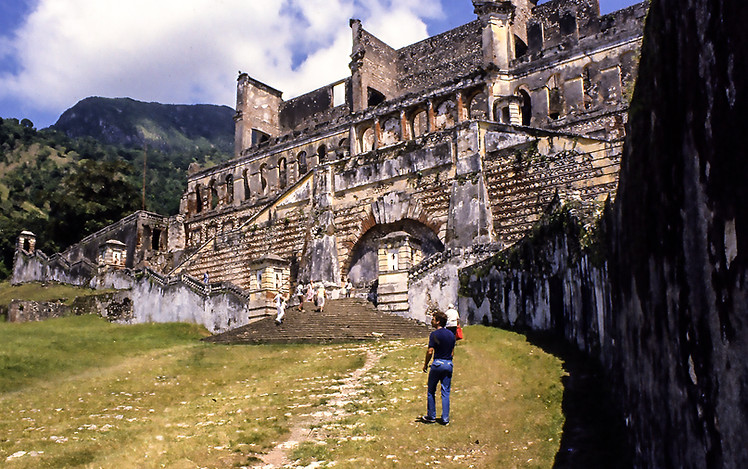
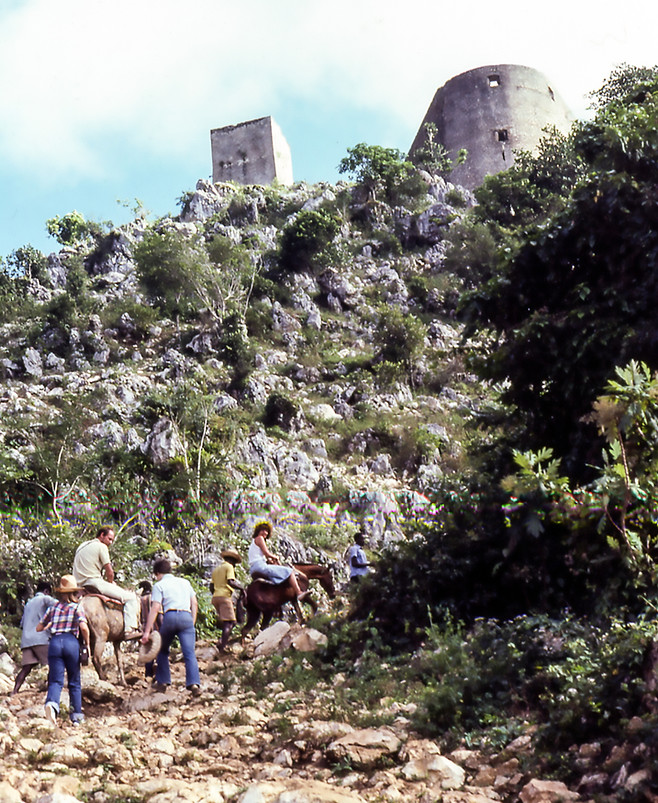
The picture left shows Glen and Niki walking up to the Citadel.
Above shows Horst at the Sans-Souci, which is where we parked to walk up to the Citadel.


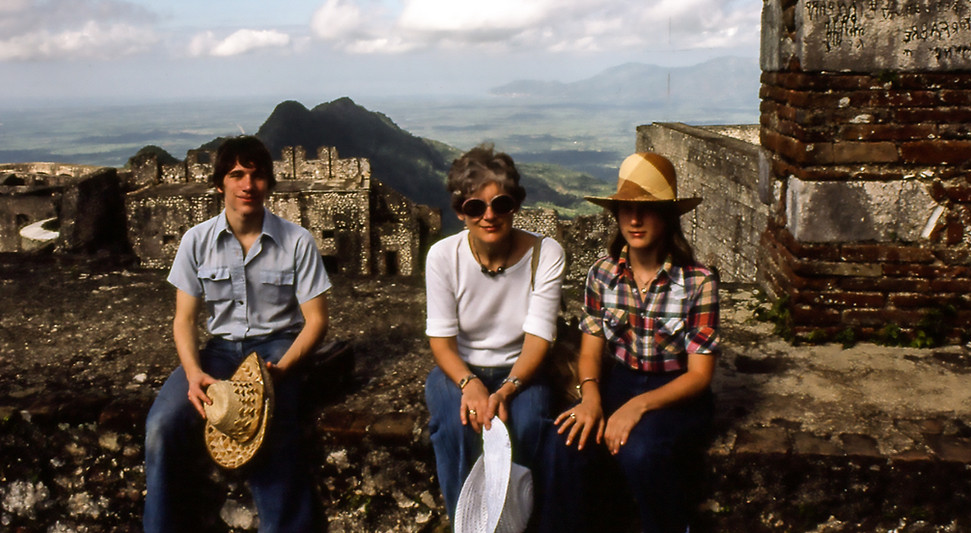
Niki and Glen are sitting on one of the many ancient cannons that were laying all over in the citadel, as you can see in the picture above.
The cannon were beautifully decorated. They were not made in Haiti, but were taken off war ships of the early 1800s and hauled up to the citadelle to repulse any attack by the French to take back their colony.
As it happens, they were never used for that purpose.

There's so much to tell about our time in Haiti, it would take a separate book to tell it all. But I do want to mention here some special places, which made our time in Haiti so unique. One of the special places was the Iron Market, which was destroyed in the earthquake, but partially rebuilt later. I'll let a couple pictures tell the story.


The Oloffson
Another famous place down near the waterfront, was the Oloffson Hotel. It is known for the celebrity guests who stayed there, including Marlon Brando. Some of the rooms are named for the famous people who stayed there when they visited Haiti. For us, the greatest feature of the place was the huge veranda, where we spent many hours sipping their famous Rum Punch, and listening to the little Haitian boy who sang for the guests.
I also remember the time we went to the Oloffson after a day at the beach and quenched our thirst with Rum Punch. It was a big icy glass of fresh tropical fruit juice with a shot of their great Barbancourt Rum. Margrit drank a little too much that evening, and Horst and I had to carry her home and put her to bed.


Video of Oloffson: https://filmhaiti.com/en/magic-oloffson-haitian-documentary/
Since we're on the subject of rum, we can't leave out our trips up to the Rum Factory to sample their rum liquers. The woman who owned the factory was married to a German who used to be a parfumier, and extracted all his own scents from flowers. He used the same technology to extract the essences from Haitian fruits and plants for his liquers. He used everything imaginable, including mango, citrus, and even coffee.


We liked most of the liquers we sampled, but the best of all for my taste was the 8 year old special reserve Barbancourt Rum (Rhum). I don't remember what we paid for a bottle then, but today it's about $29.00.
Snorkeling was also fun. There was a catamaran called the Yellow Bird that we would take out to some small islands where snorkeling and diving was the best. The water was so clear you could see the tropical fish and coral 30 feet below. A large group would usually go from USAID and the Embassy. The view of the island from the sea was especially impressive.

In the second half of my tour in Haiti, from October 1981 until August 1983, I was the Deputy Director of the Office of Development Resources and Evaluation (DRE). We designed and managed the mission's Joint Project Implementation Planning and Monitoring System (JPIP) – there was of course an acronym for everything we did in government. We also planned and managed the Mission's computerization and ADP systems development. This was the time when automation was in its infancy. We had just recently converted from typewriters to the WANG Word Processor. I did a lot of the statistical analysis of our evaluation data using a hand-held Texas Instruments calculator. The WANG was relatively large with a processor, monitor and keyboard all in one unit. It was not a computer, but its software included what they called a “math pack” which gave it the ability to add, subtract, multiply and divide. I used this capability in my work to organize and manipulate data from my surveys to facilitate more sophisticated analysis, such as regression analysis, by calculator or the first simple computers like the Apple or IBM desktops. Regression analysis is a set of statistical processes for estimating the relationships among variables. I used this type of analysis on the data from the school feeding evaluation.
Before leaving Haiti, I was invited to a conference in Guatemala, convened by AID/W Office of Information Resources Management (IRM). They wanted me to explain my analytical work in Haiti, and my use of the technology available at the time. During this conference IRM asked me to work with them when I returned to Washington after completion of my tour of duty in Haiti.
Superior Unit Citation
One final note before leaving the subject of my Haiti tour. Shortly after returning to Washington, USAID Haiti was awarded a unit citation for the work we did. I was proud to be one of the recipients of this award, which was presented in a special program at the State Department. The Citation, displayed below, says it all.

Systems Analyst in AID/W (September 1983 - May 1986
From September, 1983 until May, 1986 I worked in Washington, D.C. with AID/M/SER/IRM in the Division of AID/W Program Services as a Systems Analyst. In that capacity I provided automation and organizational management support services to the Near East Bureau (NE), the Bureau of Food for Peace and Voluntary Assistance (FVA), and the Bureau for Private Enterprise. During this time I managed a contract with Booz-Allen-Hamilton to undertake an ADP study for the Near East Bureau, managed the design and development of a major PVO information system for FVA, designed and implemented a micro-computer system for monitoring a PL480 program for the Office of Food for Peace, acquired and installed a number of WANG PCs in all client offices and trained staff in their operation, and a number of other jobs which took me to various offices in the D.C. area as well as overseas.
From June of 1986 until June of 1988, I worked in IRM/Division of Mission and Project Services as a Data Management Officer. Among other things during this period, I planned and executed two field evaluations of automation requirements in the USAID Missions to Zaire and Cameroon, covering all aspects of the Mission's automation programs, including skills and training requirements, USAID/Embassy coordination, vendor support, telecommunications and physical environment. A report with specific plans and recommendations was completed at each Mission to support budget requests for automation.
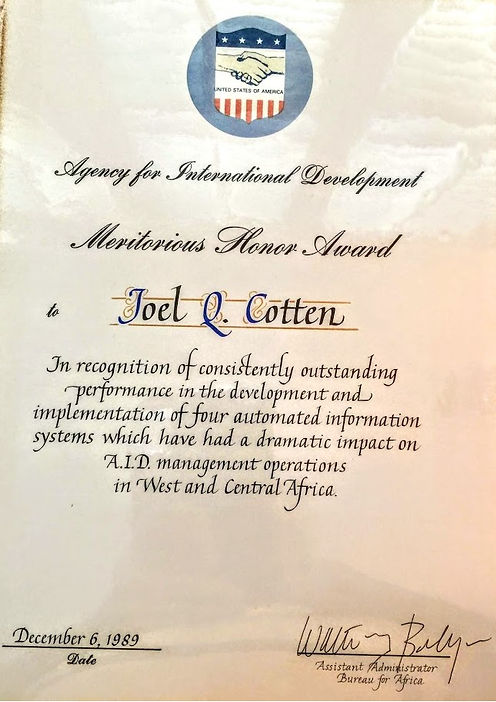
Meritorious Honor Award
I also received an award (left) for my work in West and Central Africa.
I flew to Yaounde, Cameroon via Brussels. Had a layover in Brussels for one night. For some reason my hotel room was upgraded to a very luxurious suite. There was a beautiful bouquet of flowers on the coffee table in the living room.
I enjoyed sitting in the Grand Place, the central square of Brussels, surrounded by opulent guildhalls, the city's Town Hall, and the King's House. Belgian beer was great.
Unfortunately I don't have any pictures from these trips and don't remember many specifics about the work.
Both Glen and Niki got their PhDs from UNC following different routes which they can relate separately if they so desire. Needless to say, Margrit and I are very proud of their pursuits and accomplishments.
At the time we returned to Washington from Haiti, our Burke house was rented so we bought a townhouse in Annandale, Virginia and lived there until 85, and then moved to our Burke house until 1987 when we sold it to a Taiwanese couple. We moved into a temporary apartment at 6022 Edsall Rd in Alexandria while we awaited completion of our new apartment on the 9th floor of the Belvedere condominium. The Belvedere is a beautiful new high-rise in Arlington, Virginia overlooking the Iwo Jima Memorial, the Potomac River, and the Lincoln Memorial on the other side of the river. I have pictures of the Belvedere that you can see later in the story when I talk about our retirement from the Foreign Service.
Beach Cottage
Sometime during this period we also bought an apartment in Beach Cottage at Indian Shores near Tampa in Florida. We were right next door to the Suncoast Seabird Sanctuary that took care of injured Pelicans and other birds from the area. The sanctuary was covered with netting and in the evening the wild herons and pelicans would fly in to roost there for the night. It was fun to watch.
Before leaving for our next assignment in Africa, we arranged with a Realtor on Gulf Blvd to rent our apartment to vacationers. Rentals were by the week and during the high season were quite lucrative.


From the balcony you could see the beautiful white sand beach and the Gulf of Mexico.
We also looked down into the Suncoast Seabird Sanctuary.


Abidjan, Ivory Coast
My next overseas assignment was with the Regional Economic Development Support Office (REDSO) in Abidjan, Cote d'Ivoire (Ivory Coast) from June, 1988 until August, 1992. This job involved a great deal of travelling to support 24 USAID Missions in West Central Africa, from Mauritania to Zaire. Most of the countries in the region were a part of what had been the French colonial empire and the French influence was still apparent including the language.
We lived in an area called Deux Plateau. I remember a little shack across the street called a “depot de pan”, where, as the name implies, we could get fresh baguette They were stacked up like chord wood and smelled like they just came out of the oven.
Our front yard was walled in with a gate and a stone walkway to a front porch. We often ate breakfast on the porch. There were two large Frongipani trees in the front yard that had beautiful, large, fragrant, white blossoms that would fall to the ground. We'd pick them up and float them in a bowl of water for the breakfast table.
We had two servants then that made life very pleasant. Gouba, was the cook, and Youssef, a younger man, took care of the yard. Gouba was employed by the previous French occupants of the house, and learned his cooking skills from them, so he had a great repertoire of French dishes. He also did the shopping for fresh vegetables and fish in the local markets.
Flying around West Africa was not very pleasant. I didn't particularly like sitting around in the dirty airports and flying Air Afrique was not always a pleasant experience either. One of the places I did enjoy was Dakar, Senegal. It was always an overnight stop when my destinations were places like Nouakchott, Mauritania just North of Senegal, or Bissau, in Guinea-Bissau, or Conakry, Guinea to the South. If I was going to any of those places, I stayed at the Novotel Hotel in Dakar and then flew out the next day. The Novotel overlooked the Atlantic Ocean, and was a nice place to stay.
The Novotel had a wharf jutting out into the Atlantic which was a pleasant place to sit in the evening and enjoy a cold drink. That's where I'd usually go after dinner.
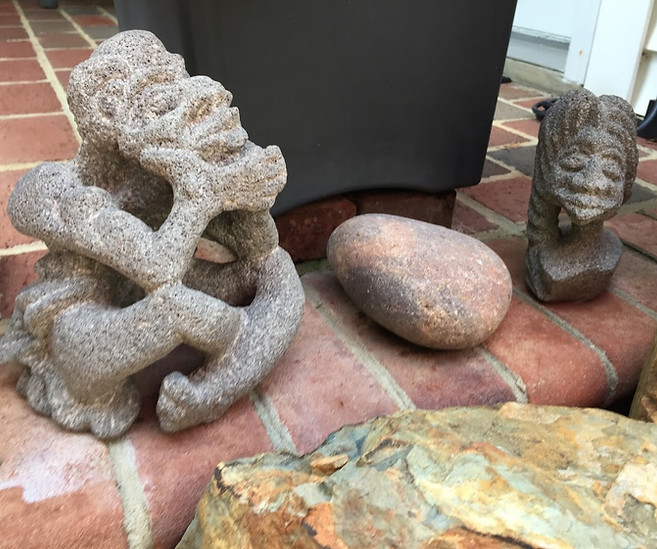
I was sitting there one evening, when I heard a strange clicking sound coming from under the wharf where I was sitting. I looked down and there, among some volcanic rocks that had washed up on the shore, was a boy with a large spike and a hammer, sculpting figures out of the stone.
I bought a couple of his "grotesque" figurines, and they now sit pondering my garden.
The Mauritanian Desert
One of my side trips from Dakar was to Nouakchott, Mauritania. I arrived in a sort of sand storm, or maybe that's what it was always like in Nouakchott. If there was any wind at all there was plenty of sand to blow around. I stayed in some USAID housing, which was adequate, meaning it had a toilet and a bed. I had to put wet towels on the floor by the door so the sand didn't blow into the room. The AID Mission gave me a truck to get around in while I was there. That evening I headed for the Embassy, because that was the only place you could get a drink. Mauritania is a Muslim country and alcohol is officially forbidden. Of course the Embassy is officially American soil, so Mauritanian law did not apply. Many Mauritanian officials knew that of course and found a reason to get to the bar in the American Embassy as often as they could.
The trip to the Embassy was rather interesting. I got part way there and the road disappeared. A sand dune had drifted across the road, and I could see vehicle tracks heading out into the desert. I didn't follow them, needless to say. I headed in the direction I was going until I could see the street again ahead of me. Now it was clear to me why USAID was providing assistance to Mauritania to fight desertification, among other things.
Nouakchott lies in a region known as the Sahel, the zone between the Sahara to the north and the Sudan Savanna to the south. It stretches from the Atlantic Ocean to the Red Sea and includes parts of northern Senegal and southern Mauritania. USAID supports initiatives to improve health, nutrition, and water, sanitation and hygiene conditions for vulnerable households in the country.
Crickets in Bissau
On another trip I flew South to Bissau in Guinea-Bissau. The plane was an old two prop type and the pilot was Cuban. This was in 1991 or 92. We sat in a kind of harness with our backs against the side of the plane. Strange. Well, we made it to Bissau, but we were greeted by an invasion of crickets. The swarm covered the entire city. I remember driving or being driven into town in the evening. You could hear the crickets crunching under the tires of the vehicle and the swarms were so thick around the street lamps you could hardly see the light.
Guinea-Bissau was once part of the kingdom of Gabu, as well as part of the Mali Empire. Parts of this kingdom persisted until the 18th century, while a few others were under some rule by the Portuguese Empire since the 16th century. In the 19th century, it was colonized as Portuguese Guinea. Upon independence, declared in 1973 and recognized in 1974, the name of its capital, Bissau, was added to the country's name to avoid confusion with Guinea (formerly French Guinea). Guinea-Bissau has a history of political instability since independence, and no elected president has successfully served a full five-year term.
Cashew nuts are central to Guinea-Bissau's economy. I remember driving through plantations of cashew nut trees. I think that's the first time I saw the cashew nut growing. A single cashew grows out the end of a large fruit.

While in Abidjan, my nephew Steve and his mother visited us. We drove up to Yamoussoukro, the capital of Côte d'Ivoire. It's known for the enormous Basilica of Our Lady of Peace of Yamoussoukro, with its stained-glass windows and towering dome. They say that it's a meter taller than St.Peter's in Rome. The city is the birthplace of Félix Houphouët-Boigny, who was president of Côte d'Ivoire during the time we were there. His palace is also unusual, surrounded with a crocodile-filled lagoon. We watched while some people threw live chickens down to the crocodiles.

We drove further up country to Bouake and beyond. Our friends, Bob and Eve Ayling lived in Bouake at the time. Bob is an Australian-American who worked with WARDA, West Africa Rice Development Association, headquartered in Abidjan at the time. WARDA was involved in the development of improved varieties of dryland or rainfed rice to contribute to poverty alleviation and food security in that region of Africa.
The open markets at various places along the road were also interesting to wander through. I remember large herds of goats walking in the road and a goatherd with his staff chasing them off so we could drive through. Something you don't see every day in the U.S.
Other places I travelled to while in Abidjan were the USAID Missions to Ghana, Togo, Benin, Nigeria, Cameroon, and Zaire (Democratic Republic of Congo today). Some recollections of these places are pleasant and others not so. Places like Lagos, Nigeria, for example, did not leave a good impression. I used to refer to it as the arm pit of the world. In fact, there's another part of the anatomy that would describe it better, but I'm in a charitable mood. The drive from the airport to the Embassy was an unbelievable scene of teeming humanity and urban squalor. There are probably some nice places in Nigeria, but Lagos is not one of them.
Kinshasa, in Zaire was a little nicer. The Congo river is very impressive - very wide where it flows past Kinshasa – like the Mississippi. When I was there it was muddy and full of floating trees and vegetation as though there had been a recent storm upstream.
Programatically, nothing really comes to mind during my travels in the region. Of course, I was not functioning as a Program Evaluation Officer during my Abidjan tour, but rather as an Information Management Officer, so my focus was on Data Systems and Automation. I was the so called “computer expert” and that quite often meant … fix the hardware … not really my idea of my job description.
R & R to West Berlin
During the Abidjan tour, Margrit and I went to Germany. We were invited to visit Don and Ellen Hayes, who were living in West Berlin at the time. You may recall that we met them in Saigon. Don was an Admin Officer at the U.S. Embassy there with whom I used to play Squash in a court out near Thon Son Nhut airport. He's the one who advised me to leave Saigon earlier than I had planned.
If I remember correctly, we flew to Frankfurt and took a military train from there to Berlin. I don't know why, but we were treated like VIPs at the station and were given a private cabin on the train for the two of us. I do recall that we did not know the route the train was taking because it was kept secret at that time due to terrorist activity, including blowing up train tracks, by the Red Army Faction, also known as the Baader-Meinhof Gang, a West German far-left militant organization that was still active at the time.
We stayed in a villa in the beautiful district of Charlottenberg in West Berlin, which was the same residence that Don’s father had occupied as a military officer during the American occupation just after the war. We stayed in an annex of their residence.
The area had many beautiful lakes and parks. The subway system (U-Bahn) provided easy acces to all parts of the area.

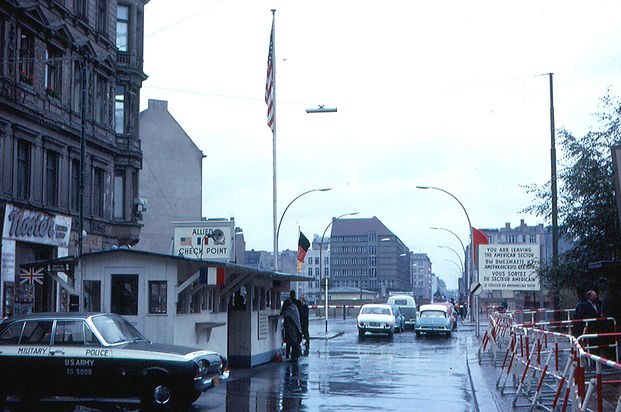
While there we drove thru checkpoint Charlie into communist East Berlin.
I remember driving through in an American Embassy car and showing our Diplomatic Passports without rolling the windows down.
First there was an American checkpoint and then an East German checkpoint
East Berlin was rather bleak at the time.
The department stores were practically empty of merchandise. We did buy some crystal vases while we were there. East Germany was famous for its cut crystal glass.


The contrast between East and West Berlin was most evident when we visited the famous Kaufhaus des Westens (Ka De We) one of the largest and most luxurious department stores in the world.


It wasn't long after our visit to Berlin that the Wall finally came down and Germany was reunited.

During our Abidjan tour we took another trip with Margrit's sister Gaby and her husband Horst. We rented a small RV and drove down the Danube all the way to Budapest. If my memory serves me, it was the Summer of 1990, one year before the end of the Soviet Union, and a rather unsettled revolutionary period in the Balkan countries, including Hungary. I remember first seeing the Danube at Passau, a German city on the Austrian border at the confluence of the Danube, Inn and Ilz rivers. Large cruise ships were docked there to take on passengers going to Budapest. We drove along the Danube all the way to Vienna and then on to Budapest, the capital of Hungary. Budapest is bissected by the Danube. Its 19th century Chain Bridge connects the hilly Buda district with Pest on the eastern shore. A funicular runs up Castle Hill to Buda's Old Town. The beautiful Parliament Building is on the Pest side of the river.
On the way back we stopped in Kitzbühel on the beautiful Wolfgang See and ate at the famous Weißen Rössl (the White Horse Inn). Kitzbühel is a world famous ski resort in the Tyrolian Alps. Our next stop was Salzburg, the home of Mozart, before returning to Bensheim/Auerbach where Margrit's family still lives.