A Cotten Tale
by Joel Quentin Cotten
My Artwork
The Mayan Civilization - El Salvador, Guatemala and Honduras


While posted with USAID in El Salvador, my artwork was influenced by the uniquely powerful and monumental art of the Mayan Indian Civilization. El Salvador was on the periphery of the Mayan Empire. Its center was the Peten region of Guatemala. I visited the major Mayan ruin of Copan in Honduras during this time where I saw the huge stone stella depicted in the drawings above. These pieces, about 26" x 42", are done in India Ink on a textured rice paper. The above pieces were sold at my show at CASA Bank in San Salvador.

All this was perfected and finished by the creator and trainer of everything, who is mother and father of life and creation, and who communicates breathing and movement, and who gives peace. He is the clarity of his children, and he has the care and maintenance of the remonstration that exists in heaven and on earth, in the lagoons and in the sea.

Popol Vuh (see above) is a cultural narrative that recounts the mythology and history of the K'iche' people who inhabit the Guatemalan Highlands northwest of present-day Guatemala City. It is a creation narrative written by the K'iche' people before the Spanish conquest of Guatemala, originally preserved through oral tradition until approximately 1550 when it was written down. The survival of the Popol Vuh is credited to the 18th century Dominican friar Francisco Ximénez who made a copy of the original text in Spanish. The name "Popol Vuh" translates as "Book of the People". The Popol Vuh includes the Mayan creation myth, beginning with the exploits of the Hero Twins Hunahpú and Xbalanqué. Popol Vuh's significance lies in the scarcity of early accounts dealing with Mesoamerican mythologies due to the purging of documents by the Spanish Conquistadors.
At right above a stone sculpture of a Mayan Lord. The stone was from an excavation near Copan. The stone had a vein of fine chalk-like pumis which I was able to carve with wood carving tools.

At left is a "composite glyph" done in natural pottery clay given to me by Carlos Mejia, a ceramic artist I met in San Salvador. He fired the piece in his kiln and it came out the color of brick. I then finished it in acrylic to give it an antique bronze look.
I call it a composite glyph, because it incorporates many of the Mayan symbols seen in Mayan hieroglyphics including the jaguar and the frog which is depicted on the reverse side of the sculpture.

Above is my work area in our house in Escalón in San Salvador.

At left is another large scale drawing of a Mayan Chief in full regalia, done in India Ink on textured rice paper.
At right is the Nebaj Jade, a Mayan Lord's breast plate.
The original is somewhat smaller and made of semi-precious jadeite.
My replica was made from plastilina and then a casting in sculptamold. It was finished in acrylic to achieve the jadeite effect.
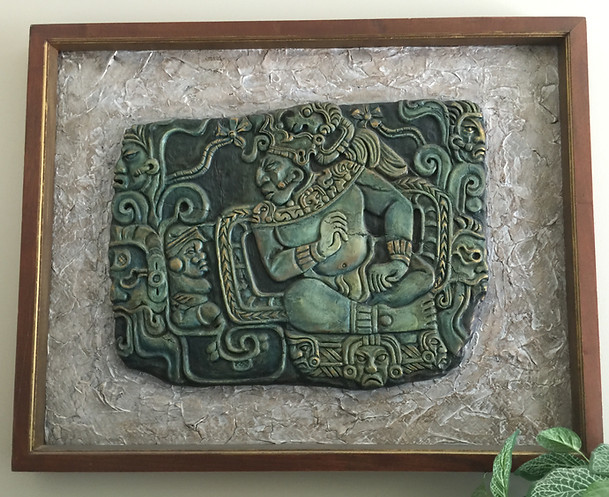

Altar 8 from Tikal
The art piece at left is a high relief replica of a Mayan sacrificial altar.
It depicts a prisoner bound in preparation for a ceremonial sacrifice.
A picture of the actual stone altar can be seen below.

At left is the actual stone altar from the Mayan temple ruins in Tikal.
It is presently located in the Museum of Archaeology in Guatemala City

On the left is my original wood carving of a Mayan Lord holding a sceptre.
At right is a sculptamold casting of the carving at the left, mounted on a board and finished in acrylic.


At left is my wood carving of the capture of Jewelled Skull by Bird Jaguar.
The subject is described by the Mayan picture glyphs which surround the piece.
The date of the event is denoted by the numeric glyphs in the upper left indicating the year 750 AD.
Jewelled Skull is named in the fourth glyph at the top as well as the tatoo on his thigh.
Bird Jaguar is identified by the second glyph on the right showing a bird sitting on top of a jaguars head.
The Haitian Period

Above is an art piece I did in Haiti on commission from Aaron Williams. It's a high-relief sculpture of Henry Tanner's 1893 oil painting entitled, “The Banjo Lesson”.
Aaron is now living in Reston, Virginia. Since I did not have a picture of this piece, I recently contacted Aaron to send me a photo of the sculpture, which now hangs in his living room.
Here's a link about Tanner and his famous painting: https://smarthistory.org/tanner-banjo/
Manaman ac Pitit
This work depicts the universal bond between mother and infant ... a heartwarming moment of tranquility and contentment when the mother has given her substance to nourish the life she cradles in her arms.
Mother and Child
The bandana is real fabric embedded in clear acrylic.
The earring is real metal.


Calling the Wind
The boy with the Conch shell represents "Agoueh", the Voodoo mystery personifying water and the sea.
The Conch shell or "Lambi" is one of his magic attributes with which an initiate "calls the wind" in order that the boat "Immamou" can set sail to "Lan z'ilets", the symbolic island paradise of the Voodoo religion.
The Haitian Revolution was a successful anti-slavery and anti-colonial insurrection by self-liberated slaves against French colonial rule in Saint-Domingue, now the sovereign nation of Haiti.
The Conch was used to signal during the Haitian war of independence in 1791.
For more on that war go to Wikipedia here: https://en.wikipedia.org/wiki/Haitian_Revolution

Le Brouettier
One of the more poignant scenes which assault the senses of the visitor to Port-au-Prince is the ubiquitous "Brouettier". This rendering depicts the grinding burden which is the lot of the unskilled urban laborer and captures the near futility of his effort to pull himself out of a life of poverty.


The Peasant Farmer


Nude carved into Haitian limestone.

Nude on Posterboard
A nude that I painted in one sitting. A bunch of grapes at the top is missing. She is plucking a single grape from the bunch which is painted in a deep purple color of the grape. I don't know when this photo was taken, or why the grapes are missing. There are also vertical scratches and color distortions that were not in the original.
I gave this painting to my friend Billy Englehardt. He hung it in his dorm at Eden Theological Seminary in St. Louis and someone stole it.
Either the thief really liked the painting, or strongly disapproved.
Famous Artists - Cartoon Course

Wynken, Blynken, and Nod one night sailed off in a wooden shoe, sailed on a river of crystal light into a sea of dew . . . . . . . . Wynken and Blynken are two little eyes, and Nod is a little head, and the wooden shoe that sailed the skies is a wee one’s trundle-bed; so shut your eyes while mother sings of wonderful sights that be, and you shall see the beautiful things as you rock in the misty sea where the old shoe rocked the fishermen three:— Wynken, Blynken, and Nod.
Eugene Field


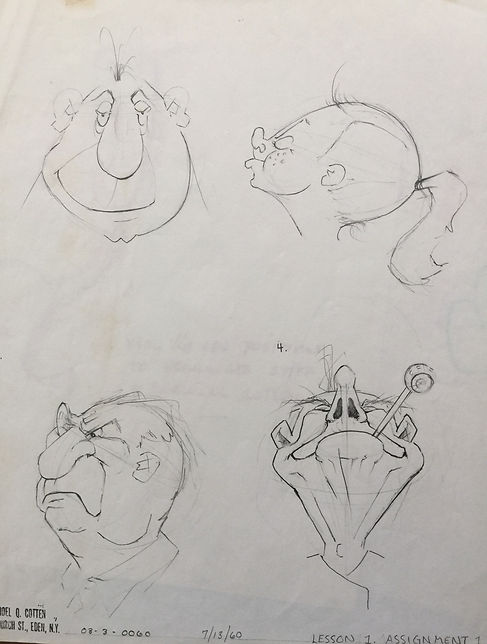


La Rochelle

Since Retirement from the Foreign Service
Marco Island

Calusa:
at one with his world
This piece, sculpted while living on Marco Island in South Florida, depicts one of the Calusa indians that used to occupy the island and the nearby Everglades.
The picture incorporates sand and shells from the beaches and cocnut fiber for hair. It is finished in acrylic paste and paint to represent the mangroves that are so common on the ten thousand islands along the shores of that part of Florida.
Below is "The Black Seminole", depicting the pre-Civil War negro slaves who fled from captivity into the Everglades and were befriended by the Seminole Indians who lived there.
The piece incorporates real shells as a necklace, coconut fiber as hair, palm fronds and croton leaves embedded in acrylic paste and finished with acrylic paint including gilt pigment to highlight the frond elements.


This is a large painting of a Bird of Paradise bush so prevalent in Florida. It was painted in our garage in Fearrington Village and hangs on the wall in our family room there.

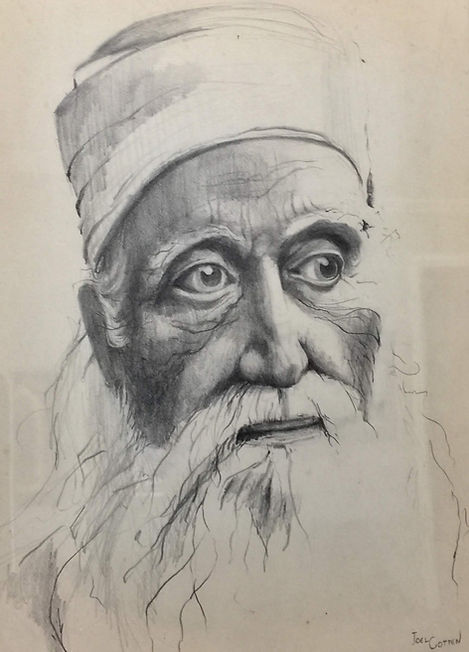

Above:
A pencil sketch of Abdu'l Baha done when we lived in Eden.
At left:
A colored pencil drawing I did while still in High School. Exact date unknown.
Mayan Lord
This is a replica of the head I carved in the stone from Copan, Honduras.
The original is done in Plastilina, then a latex and plaster mold is made, and finally a material called Scultamold is poured into the mold. When it hardens it is removed and finished with acrylic paint. In this case to achieve an ivory effect.
This piece is in Niki's home in Minneapolis.

Acrylic Pouring
In 2022 I started experimenting with the technique of acrylic pouring.
Here are two examples. The first I did for Kathy Hare and the second is hanging in our house.

