A Cotten Tale
by Joel Quentin Cotten
Overseas assignment - Croix Chapeau, France
When training was over, we awaited our onward assignment. I had requested European theater in the hopes of being sent to Germany. I always wanted to go to Germany, because my mother's parents were German. Triftshauser and Werner. Actually, Grampa Triftshauser was born in the States, but his parents were from Württemberg. My mother's mother, Magdalena Werner, was born in Alsace-Lorraine, but came to the States with her parents when she was 8. I spoke some German and even had some in school. I remember that I took a special "experimental" class in the 7th grade at Eden Central, taught by Mr. Bamberger. Why it was called "experimental" I'm not sure. Maybe because they thought it was early for a foreign language to be taught. Anyway, the army didn't send me to Germany, but to France. I was assigned to the 28th General Hospital in Croix Chapeau. That's on the West coast of France near La Rochelle.
This was 1957 and the Cold War with the Soviet Union was still on. The Soviets stayed in all the East European countries they had helped to conquer during the Second World War, and thought they would just keep moving into Western Europe, until we said no. At that time West Germany was what they called ADSEC and France was called BASEC, military acronyms for Advance Section and Base Section. ADSEC was where all the fighting troops, artillery, tanks, etc. were located to stop the Soviets from pushing West, and BASEC, was the logistical support area, where there were such things as ammunition depots and hospitals, thus the brand new 28th General Hospital at Croix Chapeau.
We shipped out of the Brooklyn Navy Yard aboard the USS Upshur, and headed for Savannah, where we picked up the rotating 82nd Airborne. The bunks were stacked four high below decks. My bunk was the first or second, hung against the bulkhead. It was well below the water level and I could hear the water sloshing against the ship. They let us up on deck once or twice a day for some fresh air, and from Brooklyn to Savannah we had to pull guard duty at night. I was glad to get any chance to get out on deck for some fresh air. During the times I had to pull guard, the weather was great. The stars glistened in the sky and a couple times I saw porpoise swimming along with the ship. Unfortunately, guard duty only lasted until Savannah. The gung-ho 82nd Airborne pulled guard duty all the rest of the way across the Atlantic to Bremerhaven, which took about a week. A lot of guys got seasick on the way, but I was lucky not to be bothered by the motion of the ship.
I remember seeing the white cliffs of Dover as we entered the English Channel. We sailed into the North Sea and along the coast of Belgium, the Netherlands and Northern Germany to the mouth of the Weser river. The port of Bremerhaven on the Eastern shore of the Weser is where we finally docked. Luckily the USS Upshur stayed up all the way. That was the only ocean voyage I ever took or hope to take - at least in a troop ship. They let us up on deck and I got my first up close glimpse of Germany. I was happy and excited. Down below on the dock there was a policeman slowly pacing in a long, darkgreen leather coat. He looked very German. I knew I was there, in the land of my grandparents.
I don't remember exactly how we got to the train, but they probably took us in busses. We had a long trip ahead of us. By train from Bremerhaven to La Rochelle, France would have taken at least 14 to 15 hours. I don't remember the route we took, but I do remember gazing out the window at the scenery and the towns as we went by. We were finally approaching La Rochelle, when someone said we were passing near Croix Chapeau where we'd be working for the next year and a half or so. I knew they were building a new hospital complex, but I couldn't see any new construction. All I could see, at least on my side of the train, were fields and some tarpaper shacks. I soon learned that if we had arrived a few months earlier, we would have been living in those shacks. Luckily, the living quarters of the new complex were completed, and the guys who had been living in the tarpaper shacks had just moved into their new billets. The hospital itself was not yet finished, but all the living quarters, including sleeping areas, mess hall, library, EM Club and recreation facilities were complete. The 28th General Hospital complex was a typical military compound. Kind of a miniature Pentagon. All the different facilities, which were two stories high, were connected by long hallways. You never had to go outside to get from one place to another.
We all got settled into our living quarters and learned what the daily routine would be. Until the new hospital was completed we would drive into La Rochelle, about 15 kilometers (15 clicks in army jargon), to the old Auffredy hospital to work in the medical labs there. It was said that Napoleon was once a patient in Auffredy Hospital. La Rochelle used to be an old walled Huguenot stronghold. Huguenots were French Protestants who followed John Calvin or the Reformed tradition of Protestantism, as opposed to the German Protestants who followed Martin Luther. Protestants in France were persecuted by the Catholic majority until the end of the 18th century. The entrance to the harbor was protected by two stone towers between which a huge iron chain was stretched to prevent marauders from entering during the night by sea.


The old Auffredy Hospital, above, and the port of La Rochelle, on the left.
Wolfgang Sydow
Shortly after I arrived at Croix Chapeau, I met Wolfgang Sydow. Wolf was a Berliner, who was orphaned during the war. He went to the States to contact relatives who had emigrated there, was drafted into the American Army, and sent to Croix Chapeau. We became good friends. I practiced my German with him. He spoke with a thick Berlin accent which was evident even when he spoke English. We spent time together in the EM Club after work, talking, drinking and smoking. I didn't drink beer or smoke cigarettes until I met Wolf. He told me about his friend Marlis whom he knew from the orphanage in Berlin. She had married, had a child, but was then divorced. I guess they were corresponding, because he knew she was then living in Düsseldorf. He showed me a picture of her he kept in his wallet. That evening we enjoyed listening to a German band that performed at the EM club, and we talked about going to Germany together when we had accumulated enough leave time.
The hospital at Croix Chapeau was now fully functional and we hired a local to assist in the Lab. Her name was Jacqueline Lavignone. She was young and newly trained, but learned quickly and worked out well. Sometimes I let her practice her phlebotomy (blood drawing) technique on me. I think it was about this time that I bought an old Plymouth Coupe from a DAC (Department of Army Civilian) who was returning to the US. It needed some work so I got it cheap. It was good to have wheels to get around on my free time. Jacqueline invited me to her home for dinner one night to meet her parents. They lived in Châtelaillon, South of La Rochelle, not far from Croix Chapeau. I was treated to a typical French dinner. The entrée was soup or potage, the main course (le plat principal) was a local fish, then came a delicious selection of local cheeses for dessert. After the meal, Jacqueline's father invited me into the drawing room for a cognac and a cigar. He spoke perfect English, because he had worked in England, so I didn't have to struggle with my limited French.
Wolfgang and I explored the region around La Rochelle, known as the Charente Maritime. We drove mostly South along the coast as far as Royan. One of the most unusual things I saw during our little excursions, which I had never seen before nor since, was the "transporter bridge" across the Charente river at Rochefort. It is the only surviving transporter bridge out of five bridges that used to operate in France and one of the last eight remaining in the world. The "bridge" is a platform suspended by cables from a track running high above the river. Cars drive onto the platform on one side of the river and the platform is shuttled to the other side. Here's the website, with pictures, which tells the story of this amazing 19th century engineering wonder: https://www.pont-transbordeur.fr/
Royan was another interesting place. Royan is a seaside resort town on France’s Atlantic coast, at the mouth of the Gironde estuary. The town, built around a beautiful crescent beach, looked too white and new to be an ancient French town. It was new. During World War II, two German fortresses defended the Gironde Estuary. These constituted one of the Atlantic "pockets" which the Germans held on to, well after the liberation of the rest of France. They were totally destroyed by British and American bombers, and one of the first uses of napalm in an air bombardment. The first bombing raids, on April 15, 1945, some 10 months after D-Day, killed over 1,000 civilians and only 23 German soldiers. When the Americans returned later and used napalm, they destroyed the entire city and killed another 1,700 civilians. There was a Free French commander with the U.S. Seventh Army outside Royan, who was not informed until too late. The message was in French and the American signalman could not understand it. It took four hours to get it translated. Too late to stop the raid and save the civilians who still lived there. Oh well! C'est la guerre! The town was rebuilt in the 1950s, as part of an urbanization program and is representative of the modernistic architecture of the time. That's what we saw in '57.
Margrit Laue's Letter
Back at Croix Chapeau one day, Wolf showed me something interesting he had been doing. The Post Office at the hospital had received an unusual letter written in German and since no one there knew German, they gave it to Wolfgang to read and respond to. The address on the envelope was itself rather unusual. It was not addressed to an individual by name, but rather to a US soldier "being on the alert" at the hospital at Croix Chapeau, or something like that. It's amazing that it ever got delivered, but it did, and they gave it to Wolf to answer. The return address on the letter was from a Margrit Laue in Aachen, Germany. She had apparently visited La Rochelle on vacation with a group from the Kaufhof in Aachen where she worked. At the beach in La Rochelle, she had met a German-American GI and when she returned to Aachen, she wrote him the letter. Wolfgang discovered that the GI to whom the letter was addressed, had rotated back to the US and had left no forwarding address, so Wolfgang responded to Margrit's letter himself.
One evening when I went to the EM Club, Wolf waved me over to his table to show me something. He had been corresponding with Margrit in Aachen, and she had sent him a photograph of herself. Wolf said excitedly, "look at this!" He was holding two photos, one of Marlis, his girlfriend from Berlin, and the other was the photo of Margrit. They were so much alike, they could have been sisters. So Wolf and I started planning to go to Aachen and meet Margrit, as soon as we could get enough leave together. I don't remember exactly the date we left, some time in early February I think, but I do remember that our leave for some reason started at midnight, so of course that's when we took off. The trip took 8 1/2 to 9 hours, and I can remember that it was just dawning as we skirted Paris, then on to Reims, Sedan near the Belgian border, then Liege and finally Aachen, near the Belgian-Dutch border. As a matter of fact, there's a place called "Drei Länder Blick" or Three Country View, where there is a small monument. If you walk around the monument, in less than a minute you've been in three countries, Belgium, Holland and Germany.
Aachen (Aix la Chapelle)
Aachen or Aix la Chapelle, was the seat of Charlemagne, Charles the Great, or Holy Roman Emperor from the year 800, who had united much of western and central Europe during the early Middle Ages. Aachen is a unique city with the Aachener Dom, a magnificent cathedral, as its architectural centerpiece. https://commons.wikimedia.org/wiki/File:Aachener_Dom.jpg Aachen is also called Bad (Bath) Aachen. It was a Roman bath, known for its mineral springs and healing waters. In the center of town is the Elisenbrunnen, an iconic neoclassical pavilion, built in 1827, that features sulfurous public drinking fountains. See this link: https://translate.google.com/translate?hl=en&sl=de&u=https://de.wikipedia.org/wiki/Elisenbrunnen&prev=search
Wolgang and I drove into town, found a place to stay and bought something to eat. The food was different than the usual messhall fare. We got a couple large bottles of a local beer with porcelain, pop-off tops that could be resealed, and some rollmops. Rollmops are marinated herring wrapped around a sliced pickel and some other stuff like onion and red pepper. Boy, was that good! We rested until it was time to drive into town to meet Margrit. She was waiting under a street lamp near Friedrich-Wilhelm-Platz. Margrit was Wolfgangs date, but I must admit I liked her when I first saw her. She was wearing a beret and dark stockings. She was beautiful, and very "European", kind of the ideal image of a girl I had in my imagination. I didn't know it then, of course, but I had just met my future wife and the mother of our two wonderful children, Glen and Niki.
At that time, Wolfgang wanted to visit Marlis, because, as I mentioned earlier, he knew she was divorced and living in Düsseldorf with her young daughter, Antje. Düsseldorf is about an hour's drive from Aachen, so I took Wolf there to be with Marlis, and returned to Aachen. I had arranged to see Margrit that evening. I don't remember exactly what we did that evening, but we had a chance to talk to each other alone and get better acquainted. Wolf and I had to get back to Croix Chapeau, but I wanted to see Margrit again, so I decided to return in April. She wanted to see me again also, and had even expressed an interest in coming to America.
Verlobung (Our Engagement)
My tour in the Army would be over in June, so I had to move fast. When I returned to Aachen in April, I wanted to ask Margrit to marry me, so on the way to see her, I bought an engagement ring and popped the question. She accepted and took me to meet her family. We arranged to have an engagement party on May 10, 1959. This time I brought Wolf along, and he and Marlis, who had also decided to get together again, came to the party. I met more of Margrit's relatives, who came to help us celebrate. During that time Wolf and Marlis and Margrit and I took a Rhine cruise from Köln (Cologne) to Königswinter. The scenery in the Siebengebirge region, including the Drachenfels, was spectacular. We had a wonderful time together. Link to Drachenfels: https://www.tripadvisor.com/Attraction_Review-g198615-d1875744-Reviews-Drachenfels-Koenigswinter_North_Rhine_Westphalia.html
Margrit Ellen Laue


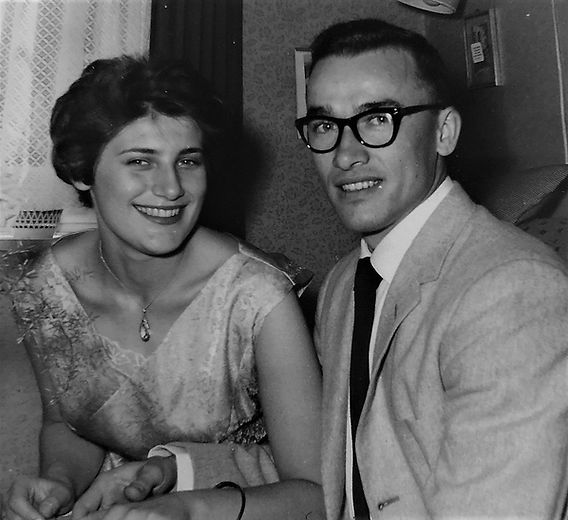
Pictures from our engagement party in Aachen.
Above Margrit, me and our dear Tante Wenny.
At left is Margrit with her friend Utta
Below Margrit's father, Tante Lotte (Margrit's mother's sister), Tante Wenny (a cousin of Margrit's father), me, and Margrit's mother (Ursula Bräutigam-Laue).
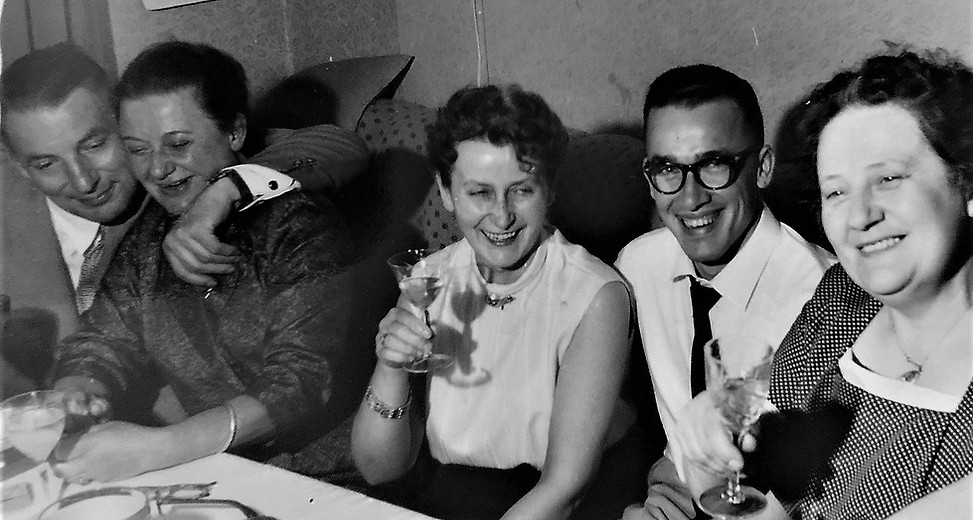
Just a funny anecdote about Tante Lotte before I move on with the story. Tante Lotte came to our Verlobung (engagement party) from Dessau, which was then in communist East Germany. She was married to Werner Wilde, who used to be part owner of a factory there. Everyone was feeling happy of course, and Tante Lotte was joking about the political system in East Germany and that the factory they used to own was now half owned by the State. She also joked about how her title had changed under the Communist regime. Her title now was the very impressive Frau Fabrikbesitzer mit halbstatlicher beteiligung - Mrs. Factory owner half owned by the State. We all had a good laugh as everyone tried to repeat that typically German tongue twister.
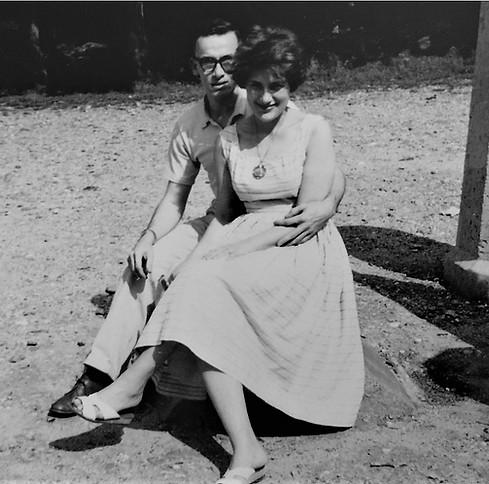
Below we're sitting at the famous "Drei Länder Blick", where you can walk around the little pillar to our left, into the three countries that all come together at that point:
Belgium, the Netherlands and Germany.
Monschau in the Eiffel - Joseph Schmitt and Tiritomba

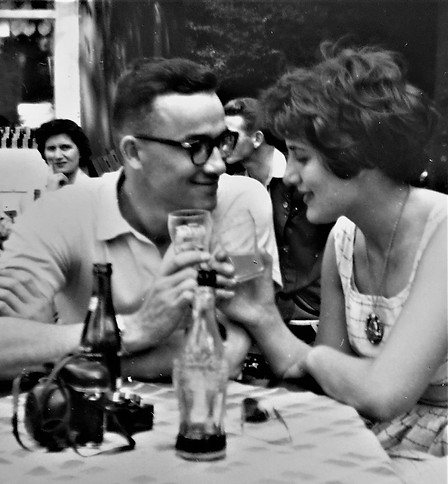
During this time we also traveled into the Eiffel region and visited the little town of Monschau. It's here that we first heard the music of the great lyrical tenor, Joseph Schmidt singing "Tiritomba". Whenever I hear him sing this song, it takes me back to this wonderful time and place. You can read about this great Jewish tenor here:
https://en.wikipedia.org/wiki/Joseph_Schmidt
and listen to him sing "Tiritomba" here:
Margrit and her family were of course affected by the war. She was born in Köthen, in east Germany, on August 31, 1937. She remembers hearing bombs falling on nearby factories as a child during the war. In 1948, at 11 years of age, she fled illegally, from what was then communist East Germany, to the West. A guide led Margrit, along with a small group of others, at night through the woods, crossing the border near Helmstedt. From there, she took a train to Köln (Cologne), where she stayed with her Aunt Ella and Uncle Karl and her two cousins, Werner and Rolf. After about two months in Köln (Cologne), she was finally reunited with her father in Schweringen, on the Weser river, in the District of Nienburg in Lower Saxony. Margrit's father could not return to East Germany, where the rest of the family still lived, because as a former Nazi, he would have been arrested by the Stasi and probably sent to Siberia. Margrit worked in Schweringen on a farm until her father found work in Aachen, in the Vaalser Quartier, through her Uncle Karl Benzine. Gradually, the rest of the family got out of East Germany and lived together for a time in very cramped quarters in what used to be an old chocolate factory that produced Sandeman chocolate. They finally moved into a small apartment on Weber Strasse in Aachen that was owned by the protestant church at the time. Margrit started working for Kaufhof, a large department store, in 1952 until she came to the States in 1960. That's where she was working when Wolfgang and I arrived in Aachen to meet her.
Back to the U.S.
So I came to the end of my tour in France, and returned to the States, where I was mustered out of the Army, as a Spec 4, Medical Lab Technician. The medical training I received in the Army would eventually serve me well to help me complete my undergraduate schooling and to go on to get a Masters degree and eventually a PhD. But, I had not yet given up on singing and as soon as I could get things organized at home, I headed for NJ to pick up where I had left off with Mrs Patton. She had, in the mean time moved to Leonia, NJ, right where the George Washington Bridge crosses the Hudson River connecting Manhattan with Northern NJ.
I found a place to live in Englewood not far from Leonia, and got a job as a cashier at a night club called the Steak Pit - a plush restaurant with a violinist circulating among the tables, etc. It was an interesting job. Part of the pay was my evening meal. I could sit at an out-of-the-way table, before the evening rush, and order anything on the menu - veal parmigiana - you name it. Pretty good deal! I learned some of the tricks of the trade, too. For example, the rheostat controlling the lighting was in the cashier's area. In the early evening when you wanted a quicker turnover to maximize the clientelle, you kept the lighting up. But as the evening progressed, and you didn't expect any new diners coming in, you wanted to keep people you had as long as possible, ordering another drink, etc. So as it got later in the evening, the maitre d' would ask me to start lowering the lights slightly, over a period of time, so it wasn't noticeable to the diners. It worked. When the lights are low, people became more relaxed, and stayed longer.
Mrs. Patton started teaching me operatic roles. The first role we studied was that of Alfredo in Verdi's opera "La Traviata". The first aria we worked on together was “Libiamo, ne’ lieti calici” from Act 1
Here's a rendition by Pavarotti: https://www.youtube.com/watch?v=pu7zWrIMV_g
I soon realized, however, with great regret, that I was not at a point where I could actually begin performing in an operatic company and make a living from it. I was almost 25, the age when many tenors are already beginning their careers. For me, two vital years had been ripped away by the military draft, at a most critical time in my vocal development. Furthermore, I had met Margrit and she was planning to come to the States for our wedding. I would have to find a full time job to be able to survive and not be a burden on anyone. I decided to return to Eden, turn my life in a new direction, and prepare for Margrit's arrival. I wanted to finish my last year at UB for my BA degree, which I didn't complete when I went to NJ instead, to study voice with Mrs. Patton.
Around this time I got a job in the Medical Lab at the VA Hospital in Buffalo. I met John Yates at that time. He was a Baha'i who also worked in the Lab at the VA. I later met his wife Pearl. Margrit remembers them both. They came to our wedding. Unfortunately, Pearl died unexpectedly, and we attended her funeral. Margrit recalls that it was the first time she ever viewed a dead person in an open casket ceremony.
Margrit arrived on April 8, 1960 at Idelwild airport in NYC aboard Sabena Airlines. Jack drove mother and me down to pick her up. The drive from NYC to Eden is over 7 hours by thruway, so we stayed over night at a motel near the airport, before the drive home the next day. We stayed at home in the old homestead until we got married. Before my father died, he purchased the Butts's place across the street. We rented it to Bob Feasley for a time after he got married. The Feasleys owned the dairy farm next door to the old house where I grew up. That's where we always got our milk.
Anyway, sometime before I was drafted, we remodeled the Butts's house. I worked with Lester Shriner. Lester Shriner, among other things, was a carpenter who built houses for Minekime. Minekime was the farmer I mentioned earlier who had the greenhouses we all worked in. Minekime at one point decided to quit farming. He subdivided his property, created two roads near us called Evelyn and Beverly, after his two daughters, and started building houses along these roads. This is when I got my building experience.
In the Summers, when I wasn't in school, I worked with Lester Shriner and some other guys building houses, from the ground up. Ed Shriner, Lester's older brother, operated a Caterpiller bulldozer for Minekime and dug the cellars for the houses. We poured the footings and the concrete cellar floors, we laid the cement block walls and built the whole house from the floor to the roof. We finished the interior rooms, drywall and all, put in the doors and windows, that were delivered already finished, put the tar paper on the roof and nailed on the asphalt shingles. In other words, we did everything except the plumbing and electrical. It was a great experience.
I learned a lot from Lester Shriner. He was a big, strong guy, who grew up in Eden, on Shriner Road, in fact, and in addition to being a good carpenter, he was a top notch baseball pitcher. I remember one time he left town to play in the minor leagues in Arizona, I think. Unfortunately, he threw his arm out in the minors and returned home to Eden, but with a wife. They settled down in Eden and I left.
So now that you met Lester Shriner, we can get back to the job at hand. Lester and I removed the old wrap-around porch on what used to be the Butts's old house and took out the door leading from the porch into the living room. It completely changed the look of the place .... not really for the better, I'm afraid .... I kind of liked that old porch. We also added a door and a small porch with concrete steps at the front of the house facing the street. Nice cosmetic touch for people driving by, but not very practical ... and as I recall, seldom used. The largest new addition was a one car garage with access to the cellar and the stairs leading up to the kitchen.
Margrit and I moved into that house after the wedding. After we moved in, I poured a concrete patio with a trellis for wisteria to climb up on. It was a pleasant place to relax outdoors and cook food on the charcoal grill. I think we also had a little vegetable garden just across a small patch of lawn.
This is how the old house looked before we remodeled it. The view in the picture is the end of the house where we built a new garage that you can see in the picture below. You can also see the old veranda at the right and the old homestead in the rear across the street.


Margrit and the house as it looked after we redid it.
I also now realize that I didn't mention the construction of mother's new house. I'll try to find a place to talk about that.
Below, I'm in the lab coat I wore when I operated the Hamburg Clinical Lab. As you can see we drove a VW Beetle then.


I've mentioned Wolfgang and Marlis. Here they are with us and kids at Letchworth State Park.
Wolf was a good friend who of course introduced Margrit and me. He and Marlis settled down in Little Rock, Arkansas.

I remember Wolf singing about the Cossacks when he had a few beers: "Wir sind voller märchen und legenden......" ("We are full of fairytales and legends..")
Unfortunately, Wolfgang has passed on. Wiedersehen, Wolf.

Our Wedding
Our wedding was on May 14, 1960. It was a Baha'i wedding which took place at the community center in Hamburg. Mrs. Holmlund, as Chairman of the Baha'i community, officiated. Most of our relatives were there. Mother made a beautiful wedding dress for Margrit. Dale, Jane's daughter, was our little flower girl, and Nancy, who was then studying music at Fredonia, played a beautiful selection (Thaïs Meditation by Jules Massenet) on the violin, while her college roommate accompanied her on the piano.
https://www.youtube.com/watch?reload=9&v=7QtGOWemQhY
I also remember a Chinese Baha'i named Chung, who read a selection in German. Margrit says she couldn't understand him. I can't imagine why. Bill Englehardt was my best man.
Anyway, it was quite an international celebration. The Bahá'í marriage ceremony is done differently in each culture. The only compulsory part of the wedding is the reading of the wedding vows prescribed by Bahá'u'lláh which both the groom and the bride recite: "We will all, verily, abide by the Will of God". The whole affair was so unusual, as weddings go, that Margrit, to this day, isn't really sure she's married. Of course we've been in that state for about 58 years now, as of this writing.


Glen was born on Christmas eve, 1961, at Children's Hospital in Buffalo. I remember the evening well. Margrit and I were already in bed, when Margrit experienced some distress and asked me to call Dr. Petzing, our Gynecologist in Hamburg. He assured us it was probably just gas, but told us to go to the hospital and he'd check her out. Well, the gas turned out to be a bouncing baby boy. Niki came three and a half years later on May 6, 1965, also delivered at Children's Hospital in Buffalo.
During the time that I was completing the last year for my BA at UB, which was now part of the New York State University system, referred to as SUNY at Buffalo, I worked at night in the Medical Lab at Our Lady of Victory Hospital (OLV) in Lackawanna. I went to school during the day and worked at OLV all night. I had a room where I could study and sleep when I wasn't working in the lab. When I arrived at OLV in the evening I would do the pre-surgical blood work on patients who were scheduled for surgery the next day. This would involve hematological testing of blood samples already collected and cross-matching of blood that would be administered during surgery. When I finished that work I could go to my room and study. I was also on call during the night for any additional blood work that might be required. I remember that I would often have a lot of work at night especially on weekends. Lackawanna at that time was the location of the Bethlehem Steel Mill and a Ford assembly plant, and the workers for those industries who lived in the area would raise hell in the bars at night, especially on weekends after getting paid, and would end up in the hospital with some kind of an injury which required lab work.
An amusing recollection from this period had to do with classes at school. I continued improving my German and took a conversation course in which we were required to read aloud. I remember our instructor was a rather buxom German woman named Fräulein Lange. I had just finished reading when she turned to me and asked me if I was from Berlin. She had apparently detected my accent which I had acquired from talking with Wolfgang Sydow, during our time in the army. My grammar wasn't that great, but I was pretty good at mimicking accents, and Fräulein Lange surprisingly picked up that gutteral Berlin accent.
Again, as I write these memoirs, I inevitably recall things that I think are probably important enough to include, so I try to find a place in this narrative to include them. When I tell about our move to Morgantown, later on in this story, I mention the Buick we drove then. This recollection then brought to mind the fact that I drove a Volkswagen beetle for some time. Remembering the beetle, inevitably brought to mind a trip we took in that car to Little Rock to visit Wolfgang and Marlis who lived there at the time. Glen must have been about two and a half then. We had arranged the back seat of the VW like a playpen so Glen could crawl around. I guess this was in the days before seat belts. Anyway, I remember driving early in the morning through the still vacant streets of Cincinnati, with Glen sitting on the potty all the way through the city.

Here's the BA diploma from SUNY at Buffalo that I received shortly after Niki came into the world.


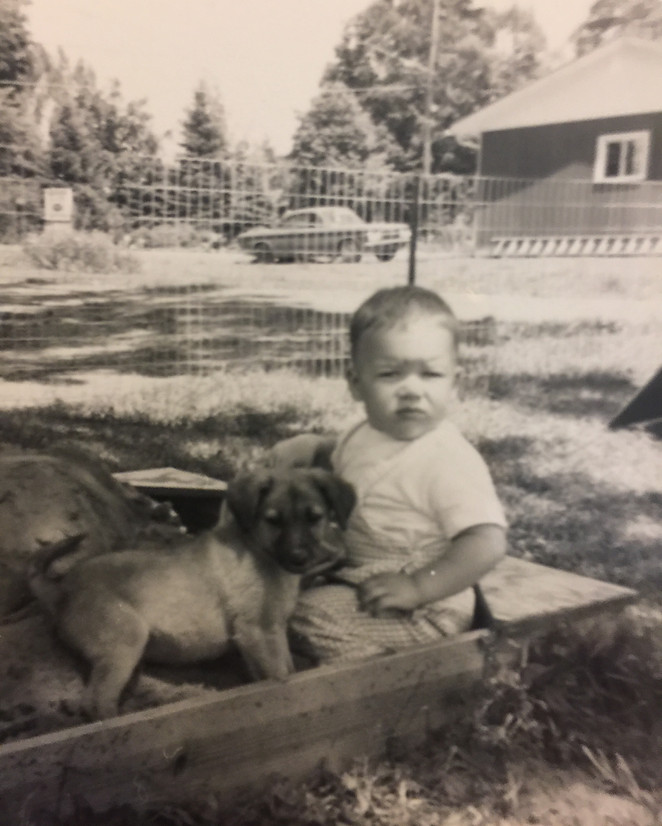
Don't have any pictures of Glen on the potty, but here are some others, including above with his aunt Betty and cousin Carole.
Here's Glen in the sandbox with Stupsi, our first little puppy. We got him from the SPCA in Buffalo.
Stupsi survived a lot, including being run over by a car. Luckily we had a great vet in Eden who put Stupsi back together in fine shape. When we went to Morgantown, Elmer took Stupsi, and he lived out his remaining days on that 15 acre farm in Fredonia.
In the background is the prefab house we built for mother. It came loaded on a flatbed. I remember helping Jack and others put it up. Also helped pour the cellar floor and power troweled it. Jack had his office in it until he moved Walanee to Gowanda.
There are so many stories to tell about the trip to Little Rock that I have to pick and choose, but there is one happening that kind of says something about the country in those days. I'd like to think there are still people like the one we encountered on our trip home, but sometimes I wonder. We were driving home, when the car broke down. The spot welds broke on the pulley on the motor that operated a v-belt that ran a lot of other stuff. So the car just quit. It was dark out, somewhere in Illinois, I think, and we had to pull off the road. No cell phones in those days either, so we had to rely on the kindness of “strangers”. As I recall someone stopped to see what was the matter and offered to contact a tow truck in the next town. We waited, and sure enough, a tow truck pulled up and hauled us into town to a service station. But that's not the end of the story. The manager of the service station told us that he'd have to order parts from the nearest VW dealer. It would take until the next day to have the car repaired, so he'd have to take us to a motel. We didn't have enough money for a motel or the repair job, so the manager paid cash for the motel and gave us a bill for the repair. We told him we'd send him a check when we got home, and that was good enough for him. So in the telling of this story, I came to realize that in those days there were no seat belts, no cell phones and no credit cards, which are all ubiquitous today. Hard to believe.
Dr. Prezna, a pathologist at the VA, asked me to operate a clinical laboratory he had just established in a new Professional Center in Hamburg. I jumped at the chance, since it was closer to home, and I would essentially be my own boss. The Center housed the offices of several Physicians, who sent all their patients to me for their basic lab work. It was in a nice residential area of Hamburg, only about a 15 minute drive from Eden. It was a real improvement over the VA job. Furthermore, Dr. Prezna was a good friend, who offered to help me financially if I wanted to go to Medical School, but I wanted to do something else with my life. I was more interested in international relations and working overseas in some kind of development work, but a more immediate concern was finishing my education, so I started exploring the programs of various graduate schools.
My brother Jack, who also became a Baha'i around this time, was developing a business in wholesale plumbing and heating supply with a Baha'i friend from East Aurora. The name of the company was Walanee Associates, built on the principle of profit sharing. Any tradesman, builder or plumber, who purchased materials from Walanee Associates, could avail himself of special discounts, if he became a member of the Association. The idea was new and revolutionary and also difficult to administer. In my spare time, I tried to help Jack with the business. I was still operating the Hamburg Clinical Lab which paid well, so I helped Jack out for nothing. I set up a mailing list of existing and potential clients and designed and distributed promotional material. Computer systems and digital technology had not yet evolved to what it is today, so I used what was available. I got my hands on an old discarded Addressograph-Multigraph machine. There were actually two heavy machines, one to stamp addresses onto a piece of soft metal, and a larger machine, that must have weighed a ton, for stamping these addresses onto a stack of envelopes. I also scrounged a silk-screen printing machine to do multi-colored promotional material for mailing. That was real automation in those days and quite impressive to see it all work.
During this time, Jack got married. This unfortunately gave rise to a controversy in the Baha'i community that was, in my judgment, a poorly managed over reaction by our national Baha'i institutions. It had to do with an obscure rule, not understood by the local community at the time, which required that if a Baha'i marries a non-Baha'i, and two ceremonies are conducted, the Baha'i marriage must be conducted first. In this case, my brother and his wife got married in her church first. This resulted in my brother losing his administrative rights, ie., being able to be elected a member of a local assembly and voting for the same. The clumsy manner in which the matter was handled by National, adversely affected an entire community, and of course the two families directly concerned. It also resulted in my voluntary withdrawal from active participation in the Faith, although I still considered myself a Baha'i.
Graduate School
I sent out applications for graduate school about this time and was accepted into the Masters Program at West Virginia University at Morgantown in 1966. Margrit and I drove to Morgantown so I could secure a job in the Medical Laboratory at the University Hospital and to find housing. We ended up finding a place to live in a community called Westover, across the Monongahela River from Morgantown. When we were ready to move our household, Jack, Paul and mother helped load our stuff into a truck and drove down to West Virginia, while Margrit and I led the way in our Buick Special. We settled in and I started with a full-time program in the Political Science department. I also worked full-time at night and on weekends at the hospital. Looking back it's hard to imagine how we did it.
I got my MA in Political Science in May, 1968, and went on for my PhD. While working on my Doctorate, I was offered a teaching assistantship and taught a couple undergraduate classes. Margrit also took a job at the Mountaineer doing office work. With both of us working, I could finally quit my night job at the WVU Hospital. During the Summers I managed to get an internship with the Agency for International Development in Washington, D.C.. As it turned out the internship was a wonderful opportunity to get my foot in the door with the Dept. of State and the associated Agency in which I ultimately built my career.
I finished all the work for my PhD, less dissertation, in 1970, and went again that Summer with Margrit and the kids to Washington for another internship with AID. We stayed in a nice high-rise apartment in Takoma Park with a big swimming pool, so Margrit and the kids could enjoy themselves. I took advantage of an opportunity that Summer, to start working full-time with AID in the Office of Management Planning.
Sometime during this period before going to Saigon on my first foreign assignment with AID, we took a trip to Germany. It was during that visit that we drove to Bernkastel on the Mosel and stayed with Margrit's Uncle Karl and Aunt Ella. Uncle Karl was a bank director, but was retired at the time of our visit. Bernkastel is a beautiful little town in Mosel wine country. Here are some pictures.


Uncle Karl told me he and a neighbor always bought a "fudder" of wine each year and put it in their cellars. A "fudder" of wine in the old days was an oak barrel which held about 1000 liters, but in the present time was bottled, so they each had 500 liters of wine. Bernkastel produces some of the finest Riesling wines available, from vineyards which climb the steep, slate-rich slopes above the town.
Uncle Karl shared a glass of that delicious wine with me and taught me how to "slurf" the wine to enhance the taste on your tongue. He said he enjoyed a bottle of his Riesling Auslese every evening. No doubt he died a happy man.
My first Foreign Service assignment – USAID VietNam
During that time I met Bill Lefes, who was getting ready to leave for an overseas job as Program Officer with AID in Saigon. He was looking for a Program Evaluation Officer, and was impressed with some of the analytical work I had been doing, and asked me to come with him to Saigon. The only drawback of course was that there was a war going on in Vietnam at the time. I discussed the job with Margrit and we decided to do it. The Agency did not permit families to go to a war zone, so they gave us a choice of three so-called safe-haven posts for the families of AID officers who would be working in Saigon. The choices were, Manila in the Philippines, Taipei in Taiwan, or Bangkok, Thailand. We chose Bangkok because it was certainly an exotic place to live, but was also relatively closer to Saigon than the other posts, and would be easier to get to when I could take leave.
So I went to Saigon. On the way I stopped in Bangkok to choose a place for Margrit and the kids to live. When I got off the plane at Bangkok International Airport it was like walking into an oven. It must have been close to 100 degrees Fahrenheit. I took a taxi to Palm Estates, a gated community recommended for AID employees. On the way into town I got my first glimpses of Thai life and liked what I saw. When the taxi stopped at a red light, women with arms full of beautiful handmade leis of orchids ran up to the window of the taxi to sell me some. The taxi driver took off before I had a chance to roll down the window.
Palm Estates was quite a nice place and lived up to it's name. We drove through a gate into a lush setting of green grass, exotic flowers and palm trees. We drove past a little pond accented with palms and flowers and parked. There were two large building each holding several apartments with beautiful balconies. The apartments that were occupied all had balconies overflowing with hanging plants and flowers. I was shown an apartment, I think it was on the third floor. It was quite spacious and the balcony overlooked the drive, the little pond and the flowers and palm trees. I could also glimpse a beautiful swimming pool next to the other apartment building.


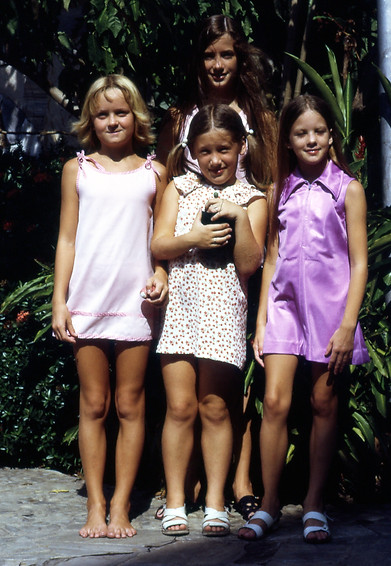

Above are Frank and Anetta Greene with their son Roy. They also lived at Palm Estates. Frank was a courier for the State Department. Our courier service has several headquarters worldwide - Washington, D.C for the western hemisphere, Frankfurt, Germany for Europe, and Bangkok, Thailand for the Far East.
The Greene's remain friends whom we still visit from time to time, because they now live in Brunswick Forest near Wilmington, North Carolina, just a few hours drive from us.
Above is Glen and Niki with Roy Greene in the gazebo, and next is Niki with some of her international friends who also lived at Palm Estates.
At the right is Margrit with Marie Louise von Muralt who was married to a German working for the UN in Bangkok. They now live in Geneva, Switzerland.

Niki is on our balcony with our maid's little daughter. Our maid's name was Lech, but we don't remember the little girl's name.
This picture shows that the family was in the apartment for a while, because it takes a while to acquire that many plants for the balcony. It was very pleasant to look out into that tropical setting.


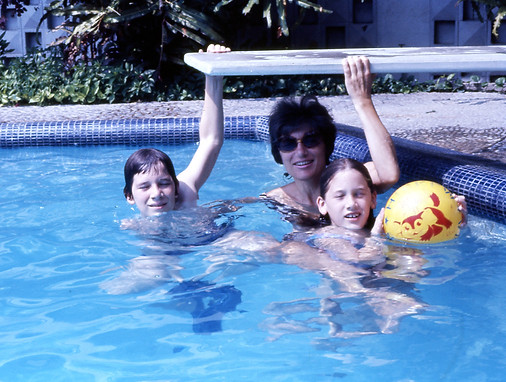


Robin Bonar and his wife Chris, at left, lived in the apartment next door. He was an Australian military attache. They invited us to their beach house which belonged to the Australian Embassy. Niki and Glen enjoyed swimming in the Gulf of Thailand.
We also enjoyed going to the beach at Pataya, where our Baha'i friend Vipa had a beach house. Below is the beach house and Margrit with Vipa and her "spook" boy friend - supposedly CIA???.

The little Mazda in the car port was our car for Thailand. The steering wheel is on the right. It took some getting used to shifting with the left hand and driving on the "wrong" side of the road.


The ubiquitous sidewalk vendors


Here are some temple scenes.
Below is a monument to a revered Buddhist sage. Note the gold leaf stuck at random on the pedestal. The Thais show their veneration for someone by applying gold leaf to their monuments.


I bought some VietNamese silk robes for Christmas. Margrit and I tried them on. They were very comfortable and pretty.
This group of pictures from Thailand are from different times during the family's stay there.
I was in Saigon then and would travel to Bangkok for extended weekends and holidays.

The Sunday market had everything you could imagine and some that you couldn't - like roasted sparrows on a bamboo spit.
The roosters you see at the right are not for eating, but for fighting. Cock fights are very popular in Thailand, and at the time were not illegal as far as I know.


We took a boat down the Chau Prya river to the floating market. You could buy everything from the vendor's boats. Very interesting and unusual to see and experience.
Encountered some Buddhist monks at a temple at the river's edge, ceremonially washing their feet to prepare for meditation and prayers.


I was favorably impressed and was quite sure that Margrit and the kids would be happy in Thailand. One nice thing about Palm Estates was that it was not an American ghetto. It was a diverse, international community. An Australian couple, the Bonars, lived next door, an American who worked for ESSO lived on the floor above with his wife, and the others you've met above. I don't remember where or how long I stayed in Thailand on the first visit, but it was not long. Just long enough to arrange with the Embassy to help Margrit and the kids get settled when they arrived later. I returned to Bangkok to help when they flew in from Germany.
So I flew on to Saigon. It was now October, 1971. As the plane descended for it's approach to the airport [Tan Son Nhut] I could see bomb craters all over the place. Somewhat unsettling, to say the least. I don't remember too much about the drive into town, but it was definitely not like Bangkok. They put me in a single room apartment in the Peninsula Hotel downtown Saigon just off the famous Tu Do Street, a block or so from the river. On the corner was a bar frequented by American military which had recently been attacked by Viet Cong and some Americans were killed. During the time I lived in the Peninsula Hotel, I ate all my meals in a military mess in a building a block or so away that housed more military.
The Tet Offensive, which culminated in January 1968, played an important role in weakening U.S. public support for the war in Vietnam. Ho Chi Minh and leaders in Hanoi planned the Tet Offensive in the hopes of achieving a decisive victory that would end the grinding conflict that frustrated military leaders on both sides.
More on the Tet Offensive: https://en.wikipedia.org/wiki/Tet_Offensive#:~:text=The%20Tet%20Offensive%20(Vietnamese%3A%20S%E1%BB%B1,campaigns%20of%20the%20Vietnam%20War.
On March 31, 1968 President Johnson made a TV address announcing that he would not seek another term as President. Thus Hubert Humphrey, LBJ’s VP ran on the Dem ticket and Richard Nixon, Eisenhower’s old VP, ran as Republican and won the election.
I knew the war was still on, because at night I could occasionally hear the dull thud of B-52 bomb drops in the distance. One night a rocket exploded quite near the hotel. It hit close enough that I could feel the impact and hear glass shattering. I remember that there was a small mosque across the street and my room was high enough that I could look into the courtyard and watch the men take off their sandals and wash their feet at a fountain before entering the mosque for prayers. The mosque was an island of tranquility in an otherwise turbulent setting.

Founded in 1961 under the administration of John F. Kennedy (1960-1963), the United States Agency for International Development (USAID) inherited a wide range of civilian assistance programs launched in Vietnam.
American assistance to the Vietnamese began before 1954, when Communist forces ended over a century of French colonial dominance at the Siege of Điện Biên Phủ. The Americans then continued to support civil society in the South after 1955, when the Republic of Vietnam (South Vietnam) declared its independence and elected Ngô Đình Diệm as president. President Ngô remained head of state with American aid until his assassination on November 2, 1963 by a rival military faction.
By 1967, President Lyndon Johnson sought to improve counterinsurgency operations in Vietnam by officially coordinating many of these civilian assistance programs with military operations under an unprecedented inter-agency organization known as CORDS, or “Civil Operations and Revolutionary Development Support.” President Richard M. Nixon (1969-1974) subsequently continued the inter-agency effort, referring to the acronym as “Civil Operations and Rural Development Support.”
The Paris Agreement for cease-fire in VietNam was signed on January 27, 1973, but the fighting didn't stop. Here's more on the Paris Accords: https://en.wikipedia.org/wiki/Paris_Peace_Accords
Here's an interesting article I recently came across about the VietNam war:
So the foreign aid program that USAID supported in Vietnam was somewhat skewed toward Security Assistance as opposed to a more normal Economic Development or Humanitarian Assistance program. In Vietnam, the need to maintain greatly expanded armed forces required a large portion of the country's total resources, resulting in large budget deficits and inflation, which required higher levels of imported resources.
At the same time that I was directly involved in designing and evaluating the implementation of projects which supported this effort, I was writing a Doctoral Dissertation on that very subject. My dissertation was entitled: Management Control of Technical Assistance Projects – A Case Study. The “Case Study” was in fact the implementation of a development support operation in Vietnam, in the face of an insurgency. In other words, I was involved in the creation of a new management process, which was the subject of my dissertation, while at the same time, using this new framework to actually design and evaluate projects in the field.
As usual I looked for the Baha'is in the community and found some who became close friends during my tour in Vietnam. My closest friend was a Vietnamese journalist named Nguyen Ahn Dung (pronounced win an yung). He spoke some English, so we were able to communicate from the start. There was also an eccentric older gentleman, called Uncle Chu, who always hung around with Dung. Dung called him the Pagoda man, meaning he was always freeloading. But he was a delightful person to be with, because he could converse about anything. He was obviously well educated, but I never learned much about his past. He always carried scraps of paper and a pencil and would be jotting notes continuously. They were in Vietnamese, so I never knew what he was writing about.
I can't leave the subject of my dear friend Dung, without mentioning the sad fact that he was incarcerated by the Viet Cong after we left VietNam. Several years later, I was surprised to receive a letter from his nephew, Nguyen Anh De, who was then living in San Bernardino, CA. Dung had been interned sometime in 1977 or 78. After I left VietNam, he married and had a son, apparently before he was sent to prison. Nguyen Anh De sent me hand written letters and a photo from Dung sent from Prison Camp Xuan Phuoc in 1991 and again in 1994. I wrote to Nguyen Anh De in March, 1994 after returning from Abidjan. We were then living at the Belvedere in Arlington. I told him that I had informed the VietNam desk at the State Department about Dung's case and also informed two non-governmental organizations concerned with human-rights abuses – Amnesty International and Asia Watch. I was subsequently informed by Asia Watch that they were planning to send a delegation to VietNam to look into possible abuses of human rights at Xuan Phuoc, so I gave them copies of his photo and our correspondence. In September, 1995, I was pleased to receive a letter from Nguyen Anh De to let me know that Dung had been released from prison on August 22, 1995, and was living with his family in Saigon, then known as Ho Chi Minh city.

Downtown Saigon


Uncle Chu, Niki, Glen and Dung


Above is a scene from my apartment at Mot Duy Thang across the street. A guy has set up a little bicycle and moped repair shop;
Below are some pictures of Dung and me eating Pho. The little soup kitchen was set up on the same corner.
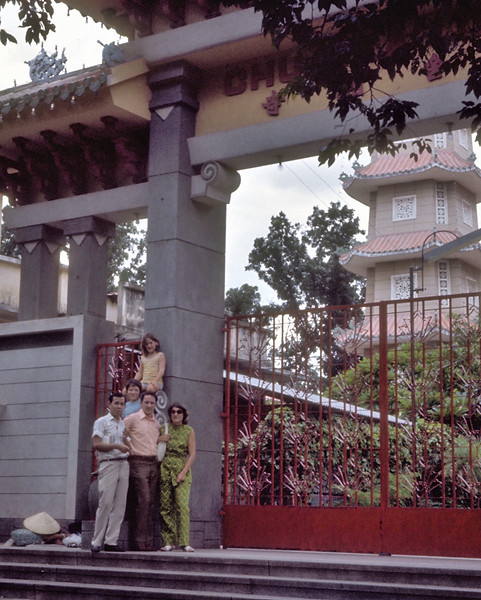


I loved the Chinese noodle soup called Pho (pronounced fuh). It was served with mint and sprouts on the side and a dash of Nuoc Mam to taste. That's the Nuoc Mam fish sauce I'm holding. Also there's some hot sauce on the table if you liked it spicey. This was served from a vendor's cart al frescoe.




There was a ceasefire on my second tour, so Margrit and the kids were permitted to live in Saigon.
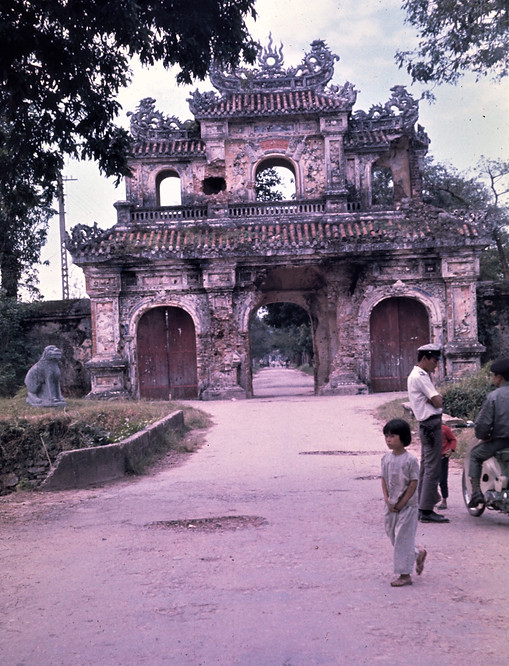
The picture above is from Hue and at the left and below is from Phan Thiet.
Left is an early morning scene of the local women squatting on a dock waiting for the fishing boats to unload their catch.
Next is a fisherman casting his net, and below is a sidewalk vendor serving a family breakfast.
I took the picture below from my hotel window.

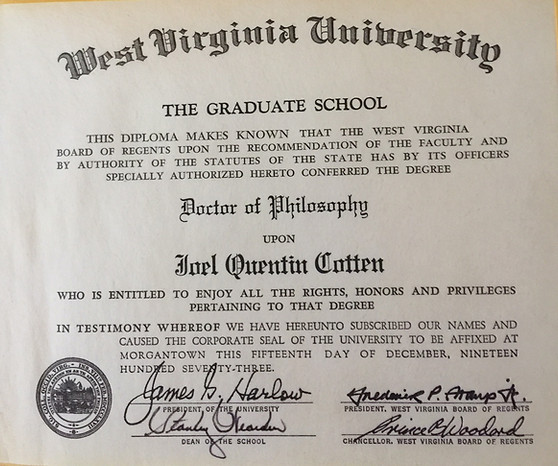
In my first year in Saigon, I was absorbed with my job and at night with completing my Doctoral Dissertation. When it was finished, I had it typed up and sent it in to the Political Science Department at West Virginia University. A time was scheduled for my review and I flew to West Virginia to defend my dissertation before a panel of professors. I defended the dissertation successfully and was awarded a PhD on December 15, 1973.
I returned to Saigon. The Paris Peace Accords, signed on January 27, 1973, ended direct U.S. military combat, and temporarily stopped the fighting between North and South Vietnam. The International Commission of Control and Supervision (ICCS) was created to supervise the cease-fire. It was composed of military and civilian personnel from two communist nations, Hungary and Poland, and two non-communist nations, Canada and Indonesia. Canada left the Commission in July and was replaced by Iran.
Iran was still ruled by the Shah. Mohammad Reza Shah Pahlavi came to power during World War II after an Anglo-Soviet invasion forced the abdication of his father. During his reign, the Iranian oil industry was briefly nationalized, under Prime Minister Mohammad Mosaddegh, until a US and UK-backed coup d'état deposed Mosaddegh and brought back foreign oil firms.
The Shah gradually lost support from the Shi'a clergy of Iran as well as the working class, particularly due to his strong policy of modernization, conflict with the traditional class of merchants, relations with Israel, and corruption issues. Various additional controversial policies were enacted, including the banning of the communist Tudeh Party and a general suppression of political dissent by Iran's intelligence agency, SAVAK. Several other factors contributed to strong opposition to the Shah among certain groups within Iran, the most significant of which were US and UK support for his regime, clashes with Islamists and increased communist activity. By 1979, political unrest had transformed into a revolution which, on 17 January, forced him to leave Iran. Soon thereafter, the Iranian monarchy was formally abolished, and Iran was declared an Islamic republic led by Ruhollah Khomeini. Facing likely execution should he return to Iran, the Shah died in exile in Egypt, where Anwar Sadat had granted him asylum.
Again I'm getting ahead of my story, but I thought it would be relevant to recall Iran's political position at the time, and the role it played in Vietnam at the time I was there. I met one of the Iranian officers, who was sent to Vietnam to monitor the cease fire. I can't remember his name, but to my surprise he was a Baha'i. You may recall that when I was drafted into the Army, I had just become a Baha'i and requested to serve as a non-combatant. I also mentioned that not all countries offered that option to citizens called into military service and Iran was one of them. The Iranian officer spoke English, so we had some interesting conversations about the Faith in the country of its birth. Persecution of the Faith was not as bad under the Shah as it is today. For an historical perspective on the Baha'i Faith in Iran go to this link: https://en.wikipedia.org/wiki/Bah%C3%A1%27%C3%AD_Faith_in_Iran
For a more comprehensive history of the Baha'i Faith, here is a link to a recent book on the subject entitled "175 Years of Persecution: A History of the Babis and Baha'is of Iran" by Fereydun Vahman. https://read.amazon.com/?asin=B07HRNLV44&language=en-US
Home Leave (HongKong, Tokyo, Honolulu)
I made a few more trips to Bangkok during my first tour in Vietnam, and Margrit and the kids were able to visit me in Saigon during the cease-fire as well. At the end of my first tour, as was the normal practice in the foreign service, we all went on home leave. Instead of flying directly to the States, we decided to take a vacation, and made some stops along the way. Our first stop was Hong Kong. We toured Victoria Peak and stopped along the way to see the little fishing villages. On another day we took a bus into Kowloon territory as far as the Chinese border, which at that time was closed to western visitors. Times have certainly changed since those days. Glen, who was about 12 when we visited Hong Kong, is now living in Shanghai and teaching at NYU there. At present Glen and Isik have returned to the U.S. and are presently living in Durham near us. We're happy to have them with us again.
Our next stop was Tokyo. The flight over the coast was breathtaking. The hotel rooms were very clean and each guest had their own Japanese robe and slippers. We liked the robes so much we bought some to take home. There was a TV set in the room and it was interesting to see the commentators constantly bowing to each other. The first day we took a taxi to the Ginza, Tokyo's most famous upmarket shopping, dining and entertainment district, featuring numerous department stores.


We ate in a little restaurant near the hotel. A display out front had artificial replicas of the dishes on the menu. We just pointed to the dish we wanted and what they brought to the table looked just like what was in the display. Unique way to solve the language barrier.


We also went to Kowloon and took a bus up to a place where you could see the border of what was then Red China. There was a man and a woman dressed in typical Chinese dress that you could take a picture of if you paid them. I snapped one from a distance without them knowing ... much cheaper that way.
People lived on their boats in the harbors around Hong Kong. Some were big Sampans, like the one above, and others like the one on the right ... somewhat smaller.


Above is the spectacular view of Hong Kong from Victoria Peak.


Our last stop on the way home was Honolulu, Hawaii. We rented a car and drove around the island. On the way we visited the Memorial of the Battleship Arizona, that was sunk at Pearl Harbor with all its crew.



In Tokyo, when the taxi pulled up to the curb to pick us up, the rear door opened automatically. When we got in I noticed that the driver was wearing white gloves. Very impressive! The Ginza was amazing – like Times Square, only more so. We went to a department store just to look around. What amazed me most was the uniquely artistic packaging – paper and cardboard delicately folded like origami. In the food section, for example, I saw three eggs standing end to end delicately held with a straw harness with a little loop at the top for a handle.
We had lunch in a little restaurant on a side street near our hotel. Again a unique experience. When we entered, the waiter, noting that we were foreigners, beckoned us back outside. He pointed out a little display window containing replicas of the various dishes on the menu. They were artificial, but as it turned out, looked exactly like the real thing. I pointed to a delicate bowl of soup with Shirataki noodles and a quails egg. When they brought me that delightful steaming bowl of soup, with a spoon and some chop sticks, it looked just like the soup in the display window.
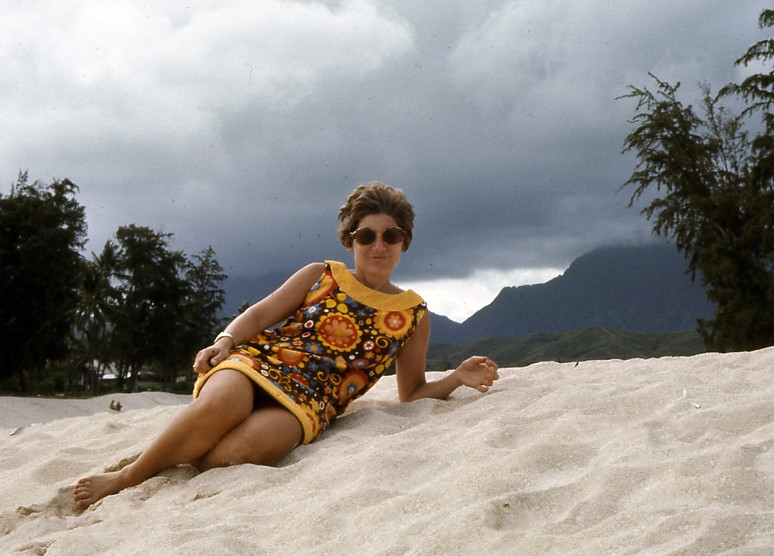
Our next stop on the way home was Hawaii. We rented a car and drove around the island of O'ahu. We saw Waikiki, took the boat to the Arizona Memorial at Pearl Harbor, drove into the interior and saw the huge plantations of pineapple, then down the Northern coast and around Diamond Head. We drove back to the airport for our flight home.
We flew to Chicago, then to Buffalo where Paul and Steve met us and we headed to Eden. After home leave we all returned to Saigon. We flew first to Germany for a brief stay, then to Karachi, where we visited some friends and bought some Pakistani rugs. It was fun shopping for rugs in Karachi. We sat in a shop on little stools and were offered some tea. The room was completely lined with hundreds of rugs of all sizes. A gentleman with a thick Pakistani accent, beckoned to his help to throw down one carpet after another, each one more beautiful than the next. The ones we liked best would be set aside. I remember this experience most vividly, because Glen was there observing the whole affair and listening to the Pakistani gentleman describing the different carpets and Glen would later mimic the Pakistani accent to perfection. To this day when ever we talk about Pakistan and our rug buying escapade, we recall the Pakistani merchant assuring Margrit, “Oh, this is the qvality, maam!”
We bought several rugs of different sizes, some of which are in our home now to remind us of our Karachi experience, and some in Niki's home in Minneapolis. The people in the shop rolled the rugs we purchased carefully, wrapped them in burlap, and tied them securely with cord, providing hand holds so they could be moved more easily. We had them shipped to Saigon.
With the ceasefire more or less holding, families with grade school aged children like Glen and Niki, were permitted to live in Saigon. We moved into new quarters in an apartment building on Hong Thap Tu street, across the street from the Cercle Sportif, a popular venue for swimming, tennis and other sports, dating back to French colonial times. We were on the third floor, which I think was the top floor of the building, so we could look across the wall surrounding the Cercle Sportif and watch a group of elderly Vietnamese and Chinese, doing their synchronized Tai Chi exercises in the morning. It was like watching a ballet.
During my time in Vietnam, I traveled extensively, as far North as Hue, which at the time was near the border with North Vietnam. From Hue to the DMZ (Demilitarized Zone) was about 50 miles. Huế was the seat of the Nguyễn Dynasty emperors from 1802 to 1945. A major attraction is its vast, 19th-century citadel, surrounded by a moat and thick stone walls. It encompasses the Imperial City, containing palaces and shrines. The Battle of Huế, during the 1968 Tet Offensive, was one of the longest and bloodiest of the Vietnam War. A lot of the old buildings were pocked with bullet holes from the fighting there. Other cities I visited included, Da Nang, Nha Trang, Dalat, Phan Thiet, Vung Tau, a beach area just South of Saigon, and CanTho, in the Delta. There are stories to tell about these places, but I'll try to fill some of that in later.
Our second tour in Vietnam came to an end a little sooner than expected. Americans were becoming tired of the war, of both the financial and human costs. President Nixon launched his Vietnamization program gradually withdrawing direct military support and Congress finally voted to cut off all funding for such support. The VC were gradually moving down the peninsula as well as through the jungles of Laos and Cambodia. Once a week or so I would go out to Than Son Nhut, airbase to be briefed on the progress of the war. There was a large map on the wall showing the movement of the VC in solid red. Each time I went there I could see the Red Tide advancing closer to Saigon.
It was time to begin thinking about our next assignment. I had been negotiating for my next post, which, though not my first choice, would have been Jakarta, Indonesia. We had already started to have our things packed in crates in preparation for shipping to our next post. As it turned out we were lucky to have a head start on most of the others, because the situation deteriorated quicker than expected. If it weren't for our anticipation of an onward assignment, our beautiful teak wall unit that we had built in Bangkok, would probably never have gotten out.
Margrit and the kids left earlier than me. They flew to Bangkok and then on to Germany. The atmosphere in Saigon changed, it seemed to be quieter, a little more tense. The roads leading into the city were blockaded with tank traps. The tension was heightened one day, when a jet fighter swept in and dropped a bomb on the Palace and flew out to sea. Shortly after that, I remember Don Hayes, a friend of mine at the Embassy with whom I used to play squash out at Than Son Nhut, asked what my plans were for leaving Saigon. When I told him, he replied that I'd better move my plans up a bit. I thanked him and moved my departure date up by about a week. I flew out of Saigon to Bangkok on one of the last flights of Air Vietnam. It's a good thing I did, because if I'd waited, I'd be taking off of the Embassy roof by helicopter. In those last days Than Son Nhut was being shelled, and planes could not take off.

I learned this story later, but it's worth telling. My friend Don Hayes, who was an admin officer at the embassy, was given the assignment in the last days, to take care of some local embassy personnel, who had been taken as a group to Than Son Nhut for evacuation. He was with them in a tennis court area, when a marine helicopter flew in and landed near by. He walked to the chopper and they told him to get on - alone. He refused, explaining that he was responsible for the safe evacuation of all the Vietnamese personnel assembled there. In keeping with his word, he stayed there until every last person was airlifted to the ships awaiting off shore. A true hero, in my estimation and I'm sure of those Vietnamese colleagues he looked after and got out safely.
From Bangkok, I flew to Germany to see Margrit and the kids for a few days and then I flew to Washington, D.C. by myself. Two weeks later Margrit came with the kids. We decided to put them in school in Eden. I worked at the State Department during this period on the Refugee Task Force. We monitored the flow of refugees from Vietnam as they moved to Guam and other places and finally to the United States. We sponsored my Secretary to get her to Washington and get her settled. I've lost touch, but I think she did quite well for herself.

This is the last cable issued by the American Embassy before evacuating VietNam.
The last paragraph is the final message from then Ambassador Graham Martin.
The Mayaguez Incident
One last recollection before leaving the Vietnam story concerns the container ship Mayaguez. In preparation for our next assignment, which was supposed to be Jakarta, we had our household effects packed into a container and had it hauled to the riverfront for shipment. Margrit and the kids left Saigon early and as I already mentioned I left earlier than I had planned on the advice of a friend at the Embassy who had better information than I regarding the collapse of the South Vietnamese army in the face of the rapid advance of the North Vietnamese toward Saigon.
Included in our household effects was a piano that we had purchased in Bangkok and the beautiful teak wall unit that we also had built by hand in Bangkok. It was our understanding that the container with all our precious things was loaded aboard the Sea-Land container ship called the Mayaguez, which we later learned had been captured by the Khmer Rouge in the Bay of Thailand when it sailed too close to some Cambodian islands in the area.
This whole incident was surrounded with mystery and I only recently discovered some research that traced the route of the Mayaguez and our container with our household effects including the wallunit.
For more information go here: https://en.wikipedia.org/wiki/Mayaguez_incident
More Revelations About Mayaguez and its Secret Cargo:

The wallunit as it looks today in our home in Fearrington Village, North Carolina.
It moved with us from Bangkok, Thailand to Saigon, Vietnam, on the Mayaguez to Hong Kong, then to Burke, Virginia, then San Salvador, El Salvador, then Haiti, then Arlington, VA, then storage in the DC area while we were in Africa, then out of storage to the Belvedere in Rosslyn, VA, then to Marco Island and Naples, FL and finally North Carolina as pictured at left.
India-Sri Lanka-Nepal Desk (May 1975 to November 1976)
My next job was also in the State Department as a Desk Officer, on the India-Sri Lanka-Nepal Desk. The "Desk" is the the name of the office in the State Department which is responsible for supporting all operations in field missions. I enjoyed this job very much. I was given a free hand in the design and subsequent implementation of an evaluation of our PL480 Food for Peace program in India. Although we did not have a bi-lateral AID program in India at the time, it was nevertheless the largest PL480 program in the world.
This was during the time that Indira Gandhi was Prime Minister of India. She was the first and, to date, the only female Prime Minister of India. She belonged to the Nehru–Gandhi family and was the daughter of Jawaharlal Nehru, the first Indian prime minister. Despite her surname Gandhi, she is not related to the family of Mahatma Gandhi. She served as Prime Minister from January 1966 to March 1977 and again from January 1980 until her assassination in October 1984, making her the second longest-serving Indian prime minister after her father.
Prime Minister, Gandhi was known for her political ruthlessness and unprecedented centralization of power. She went to war with Pakistan in support of the independence movement and war of independence in East Pakistan, which resulted in an Indian victory and the creation of Bangladesh, as well as increasing India's influence in South Asia. Gandhi instituted a state of emergency from 1975 to 1977 where basic civil liberties were suspended and the press was censored. Widespread atrocities were carried out during the emergency.
Catholic Relief Services (CRS) was the lead voluntary agency (Volag) implementing the Food for Peace program in India. They were headquartered in New York City, so I traveled there to talk to them about their program in India and which of their projects they would like to have evaluated.
I worked with Ed Fox from the Office of Food for Peace, which is part of the Agency for International Development. We flew together to New Delhi and stayed at the Akbar Hotel. The hotel was a tall building, the only high-rise structure in that part of Delhi at the time. We had rooms quite high up in the hotel, and I remember looking down to a circular swimming pool far below. There were a number of Russians in the hotel and around the pool. The USSR and India enjoyed friendly relations during the Indira Gandhi regime. We stayed in Delhi for a day or two planning the next move.
Some of our planning involved deciding which four-star restaurant we'd go to in the evening. We'd order a taxi and go down to the lobby to wait. The taxi would arrive at the front door – all the taxis in New Delhi were little, black British Austins – we'd walk to the door, which was opened by a huge doorman in a uniform and a turbin – he must have been a Sikh – hopped in the taxi and we were off to the restaurant. I remember one of the restaurants we went to. The dining area was huge, and we sat next to the kitchen which was completely open, but separated by a low bannister, so you could watch all the cooks in their tall, white chefs hats preparing the food. Very impressive and very unusual.
I also remember that we ate once in the hotel restaurant. I only mention this, because it was a rather comical experience. We sat down and ordered. I was hungry, so I ordered a steak. After a short wait, we saw the waiter approach pushing a cart carrying our food and some other apparatus to prepare the steak right at the table. The waiter went through an elaborate procedure with my steak ending with a flaming pyre which caught everyone sitting near us by surprise. The flames subsided and there on the plate was an impressive, sizzling piece of meat. I thanked the waiter for his impressive performance and he withdrew with his cart. I wished Ed Fox “bon appetit” and started to eat. That elaborately prepared steak...was the toughest damn piece of meat I ever ate. But I ate it nevertheless.
The PL480 evaluation would take us to Calcutta (Kolkata) and Bombay (Mumbai) by plane and from Bombay by train up into Gujarat. We flew to Calcutta to look at some sanitation projects in the slums of that city, which is located in West Bengal near the border with Bangladesh. The flight there was enjoyable and the view of the Himalayas of Nepal out the window was spectacular. We stayed in an old British colonial hotel. I remember looking out the window on the first floor of the hotel onto a street scene out of Rudyard Kipling. The street was bustling with traffic – ox carts, bicycles and women in saris. Immediately below the window was a man with a cart and a pile of sugar cane. The cart had a press on it operated by a hand crank. He ran a stalk of sugar cane through the press and the juice came pouring out into a glass. People were standing around drinking fresh pressed sugar cane juice.
We took a rickshaw to the project site in a very poor area of the city. It was a Food for Work project to build latrines for a large community. The Food for Work Programme (FWP) in India provided a year's employment to almost one million people annually. The FWP was initiated to generate employment, create durable community assets and rural infrastructure, and utilise the surplus foodgrain available in the U.S. The program came under criticism as a development tool, because it tended to suppress local initiatives to produce food, but the primary purpose of FWP was humanitarian, and in that regard, especially in this instance, it worked well.
During this trip I also saw how important the cow was to the life of the people in India. Of course the cow is sacred in the Hindu religion, but in the slums of Calcutta, I saw other evidence of its utility. They used cow dung as fuel. Here's a picture of cow dung patties drying on a wall. The locals would mix a little straw into the patty and slap it against a stone wall in a nice pattern with their hand print clearly embossed in it.


Rashtrapati Bhavan
Rashtrapati Bhavan
Official home of the President of India


The U.S. Embassy
New Delhi
Pool at the Akbar Hotel

One of my first impressions of India when we arrived in Delhi was the smoke rising into the air from thousands of fires burning dried cow dung for the evening meals. From my vantage point high up in the Akbar hotel I could look out over a wide area and see the smoke hanging in the air as far as the eye could see.
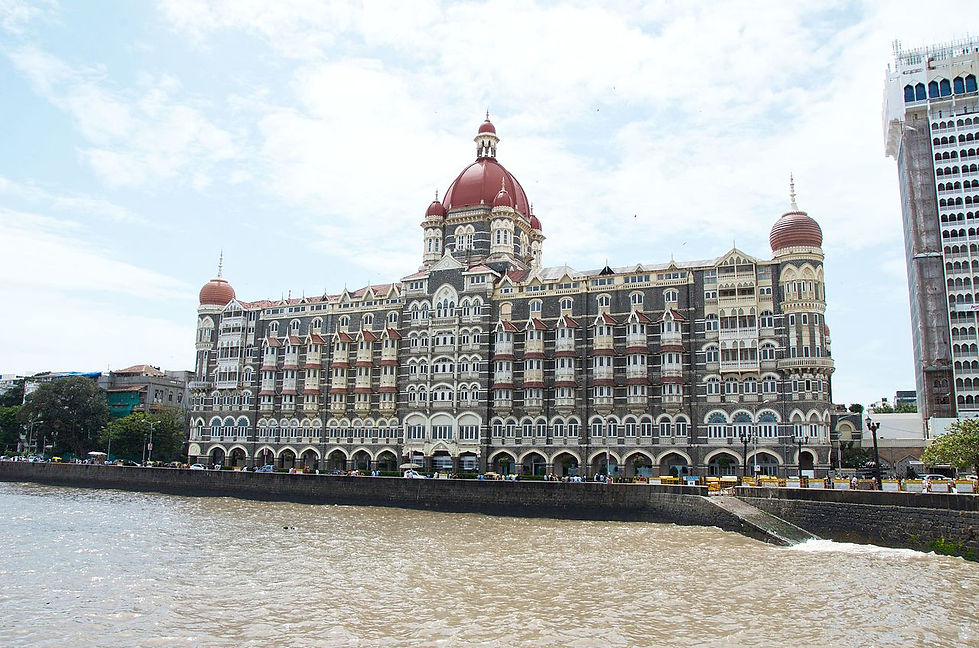
From Calcutta we flew to Bombay on the coast of the Arabian Sea. We stayed in the old Taj Mahal Hotel looking down on the India Gate, the ceremonial gateway built for the arrival of British Royalty and High Officials during the Raj. [see picture below] The British Raj refers to the period of British rule on the Indian subcontinent between 1858 and 1947. The system of governance was instituted in 1858 when the rule of the East India Company was transferred to the Crown in the person of Queen Victoria, who in 1876 was proclaimed Empress of India.
I remember walking in front of the building with a large statue of Queen Victoria seated on a throne. Near there was a large green field where they no doubt played Cricket. Beyond that was a promenade along the shore and the sea beyond.

The India Gate on left.
Below the Taj Mahal Hotel where we stayed while in Bombay (present day Mumbai)
This was the same hotel that was attacked in 2008 by Pakistani terrorists. https://www.nytimes.com/2016/02/09/world/asia/david-headley-mumbai-attacks.html
The project we were going to inspect was a boys school, run by CRS, almost a days ride by train up into Gujarat State. At the train station we were met by a woman, whom I think was a Catholic nun, although she wore a normal dress. She knew about the school we were going to visit and told us about it as we rode. She was accompanied by a tall Indian gentleman who spoke perfect English - with a British accent.
The train ride was very pleasant and interesting. The coach we rode in had windows that could be opened by the passengers, and some of the windows were open as I recall. The engine was a steam locomotive and chugged along at a moderate pace. It was early morning as we pulled out of the station, and for several miles along the tracks you could see the bare asses of people squatting by the tracks taking their morning constitutionals. I remember the big Indian gentleman, seated across from me, exclaimed, obviously quite annoyed, in his proper English accent, “Don't pay any attention, their just making a nuisance of themselves.” I couldn't help thinking to myself, the real nuisance was not having any other place to take a crap.
The train was definitely not an express. It made stops along the way, which actually made the trip more enjoyable, and gave us a chance to experience life of the Indian peasants along the way. We were riding along the coast, and in one area there was a huge expanse of salt flats, where they were harvesting sea salt. They had erected large walled areas where the sun evaporated the water leaving the pure white sea salt. In some places they had scrapped the salt into large piles to be put into bags to be sold in the markets. A very impressive sight.
Another glimpse of life along the tracks came into view as we approached a long bridge over an estuary. Along the banks of the estuary were several elephants, obviously domesticated, being washed by peasant boys in the river. So it was – one uniquely exotic scene after another - until we pulled into the little rural train station at our destination.
We were picked up by a middle aged gentleman who drove us into the country to the boys school. He told us the story of this unique school for adivasi children. Adivasi is the collective name used for the many indigenous peoples of India. Of course India's caste system is among the world's oldest forms of social stratification surviving to this day and some of these children were from the caste called Dalits - outcastes or untouchables. The system which divides Hindus into rigid hierarchical groups based on their karma (work) and dharma (the Hindi word for religion, but here it means duty) is generally accepted to be more than 3,000 years old.
The wonderful thing about this school was that it provided a means for these young adivasi to break out of their caste and go on to higher education. The young students even governed themselves. They elected their own officers and participated in the operation of the school. It was certainly heart-warming to note that our Food for Peace program was supporting this kind of activity half way around the world.


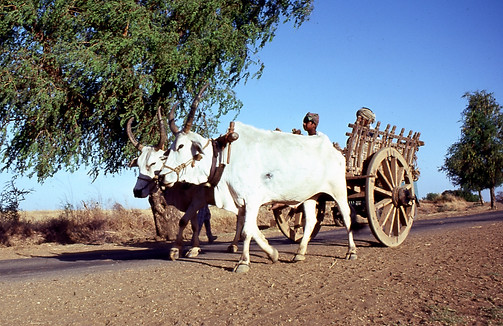


The village water well on the left.
Artisans at work. Lower left - a shoemaker and lower right a metal etcher.


Ed Fox and yours truly at the Taj Mahal.


Above - winnowing and weighing grain.
Left - a typical village scene - drying cow dung for fuel.
Below - the ubiquitous rickshaw man.

We returned to Bombay and flew back to New Delhi. Over the next several days we prepared our reports for AID/W, the Office of Food for Peace and for an oral report for the U.S. Ambassador to India. During this time we did a little sight seeing since there was so much to see near by. The Red Fort was the first place I visited since it was the closest. The Red Fort is a historic fort in the center of Delhi. It was the main residence of the emperors of the Mughal dynasty for nearly 200 years, until 1856. Constructed in 1639 by the fifth Mughal Emperor Shah Jahan as the palace of his fortified capital Shahjahanabad, the Red Fort is named for its massive enclosing walls of red sandstone.


I also visited the Qutub Minar Tower, pictured on the right.
Qutb ud-Din Aibak, the founder of Turkish rule in north-western India and also of the
Mamluk Dynasty in Delhi, commissioned
the construction of this monument in 1192
AD. He dedicated the minaret to the
Muslim Sufi mystic Qutbuddin Bakhtiar
Kaki. While some sources believe it was
constructed as a tower of victory marking
the beginning of Muslim dominion in India,
some others say it served the muezzins who called the faithful to prayer from the
minaret.
The tower, made of red sandstone
and marble is not only the highest brick
minaret in the world, but also one of the
most famous historical landmarks of India

One of the most famous, world heritage sites is the Taj Mahal in Agra, just a short drive from New Dehli. It was a week end, and the Ambassador was indisposed, so we were offered a chauffer-driven car to take us to Agra to see it. It was a good thing we were given a chauffer because the road was clogged with traffic of all sorts – not only other cars, but camels and elephants as well, all demanding the right of way. When driving on that road to Agra, both the brakes, and the horn are in continuous use. Our chauffer was an expert on the horn.
Almost everyone has seen the Taj Mahal in pictures, but it is even more impressive in real life. It is one of the most perfect structures viewed from a distance, but what most people do not realize is that it is literally a gem when viewed up close. The white marble of the building is inlaid with semi precious stones which are only seen up close.

The mausoleum in Agra is India’s most famous monument, and a sublime shrine to eternal love. Built from between 1632 and 1647 by the Mughal Emperor Shah Jahan, the Taj Mahal was dedicated to Jahan’s favorite wife, Mumtaz Mahal, who died during childbirth. But despite its iconic stature, much of its history is still shrouded in mystery. Here are a few things about the marble-clad marvel you might not have known.
https://www.smithsonianmag.com/travel/eight-secrets-taj-mahal-180962168/#udzZQYpCXrLuoo05.99
We returned to New Delhi and briefed the ambassador on all our evaluation activities on the PL480 program in India.
Nepal
Before leaving for Washington, I took a trip to Kathmandu, Nepal, since that was also one of my responsibilities as the Desk Officer for the India-Sri Lanka-Nepal Desk in the State Department.
I arrived in Kathmandu on a weekend so there were only a few people around to fill me in on the USAID program there. They provided me with a car and driver to take me up into the mountains to a project site, which gave me an opportunity to see the magnificent scenery around Kathmandu. The mountain slopes were heavily terraced, as far as the eye could see. It was amazing the amount of terracing required to get a small plot of level land to till and plant crops on.

I also spent a little time walking around Kathmandu. There were numerous temples with monkeys climbing around on them, and a lot of little shops to explore. I also saw elaborate prayer wheels in operation. Very conveniently, you just have to give the drums a spin, and they do your praying for you.

Nepal is famous as the world's only Hindu Kingdom. It's about 80% Hindu, about 10% Buddhist, a little more than 4% Muslim, and the rest are other beliefs, some, like Kirant, is indigenous to Nepal.
So it was then back to New Delhi for the long flight home. The time in India was one of my most memorable, thanks to the unique charm, beauty and historical richness of the Indian sub-continent.